Best Time to Visit Nepal: Weather, Seasons, and Month-by-Month Guide
October to November and March to April are the best time to visit Nepal for clear mountain views and trekking,…
 Himalayan Gateway Trek - On
 Mount Kailash is a 6,638-meter mountain in western Tibet that holds deep religious importance for Hindus, Buddhists, Jains, and followers of the Bon tradition. Its striking shape, remote location, nearby sacred lakes, and the long tradition of circumambulating the mountain have made it one of the world’s best-known pilgrimage mountains.
Mount Kailash stands in the Gangdise range of the western Tibetan Plateau, close to Lake Manasarovar and Lake Rakshastal. People do not visit the mountain to climb its summit. Instead, pilgrims follow the sacred circuit around it, known as the Kailash Kora or Kailash Parikrama.
Many stories surround the mountain. Some are rooted in religious tradition, while others come from modern travel stories and internet claims. This guide separates those ideas from what geography, history, and current travel information can support.
| Fact | Details |
|---|---|
| Name | Mount Kailash |
| Tibetan names | Gang Rinpoche, Kangrinboqê |
| Elevation | 6,638 m (21,778 ft) |
| Location | Western Tibet, China |
| Region | Ngari Prefecture |
| Mountain range | Gangdise Range |
| Nearby lakes | Lake Manasarovar and Lake Rakshastal |
| Religious importance | Hinduism, Buddhism, Jainism, and Bon |
| Main pilgrimage | Kailash Kora or Kailash Parikrama |
| Climbing status | No recorded successful ascent |
| Main purpose of visiting | Pilgrimage, circumambulation, and religious travel |
Mount Kailash is in Ngari Prefecture in the Tibet Autonomous Region of China, in the western part of the Tibetan Plateau. The mountain belongs to the Gangdise range and stands near the western meeting area of China, India, and Nepal. Lake Manasarovar and Lake Rakshastal lie nearby.
Its remote setting helps explain why the mountain has remained difficult to reach for centuries. The surrounding land is dry, open, and very high above sea level. Roads and settlements are limited compared with better-known Himalayan travel areas.
It rises to 6,638 meters, or about 21,778 feet, above sea level.
That height matters because most people feel the effects of altitude long before they reach the summit area. The pilgrimage routes also pass through high terrain, which makes acclimatization an important part of the journey.
At this high altitude, the air contains less oxygen than at lower elevations, so visitors may get tired or short of breath more easily. The Kora also reaches high mountain passes, making proper rest and acclimatization important before continuing the journey.

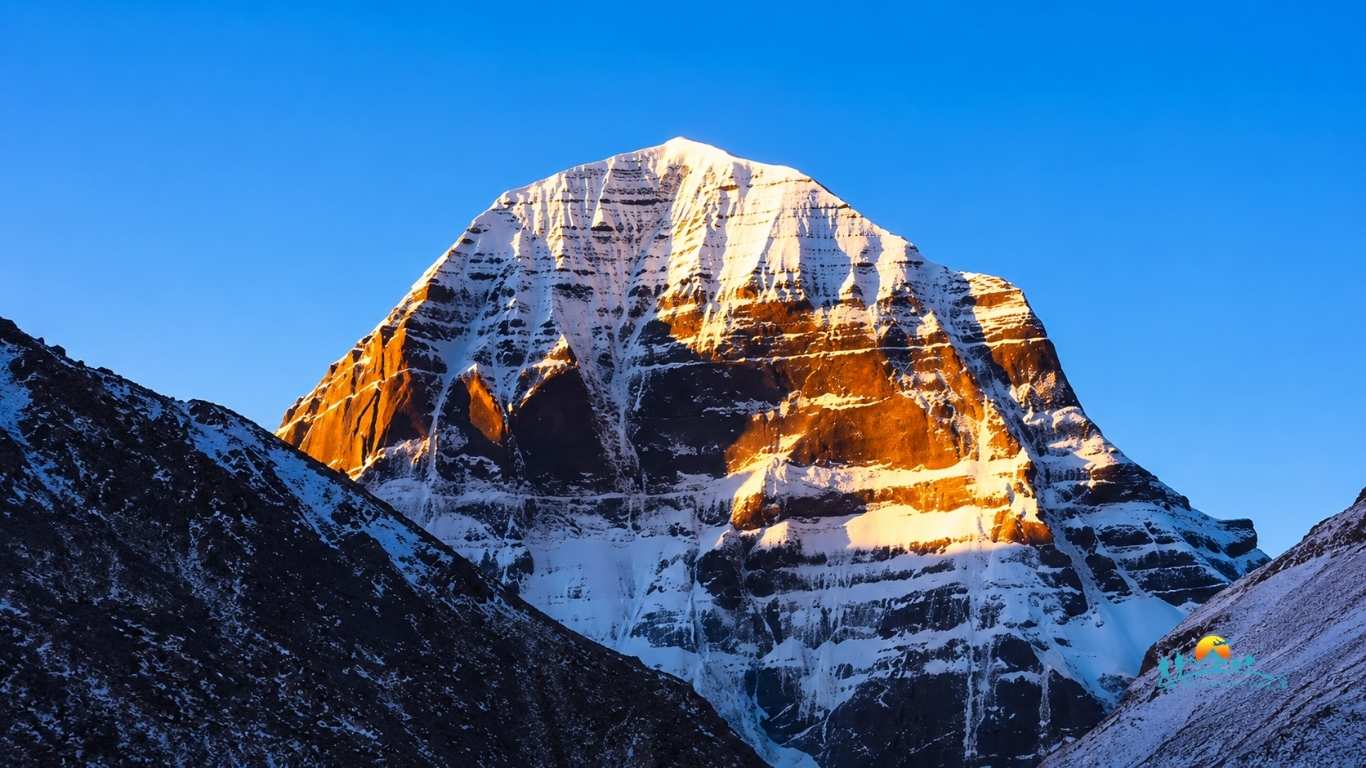
The mountain has a striking, almost symmetrical shape, with steep faces and a broad snow-covered upper section. The mountain often looks very different from nearby peaks because it stands out clearly from the surrounding landscape.
Its shape has led some people to compare it with a pyramid. The comparison describes its appearance, but it does not prove that people built the mountain or changed its shape.
It is sacred in four major religious traditions: Hinduism, Buddhism, Jainism, and Bon. Each tradition gives the mountain its own meaning, stories, and place in its religious world.
| Tradition | Importance |
|---|---|
| Hinduism | Associated with Lord Shiva and Parvati |
| Buddhism | Linked with sacred Buddhist cosmology and the deity Demchok |
| Jainism | Connected with the liberation tradition of the first Tirthankara |
| Bon | Regarded as an important sacred center in the Bon tradition |
For Hindus, Kailash is strongly associated with Lord Shiva, one of the central deities in Hindu tradition. Many Hindu traditions describe Kailash as the abode of Shiva and his consort Parvati.
The mountain also connects with the idea of Mount Meru, the sacred mountain at the center of the universe in Hindu cosmology.
For many Hindu pilgrims, reaching the Kailash region is not simply a sightseeing trip. The journey has religious meaning, and circumambulating the mountain forms an important part of that pilgrimage.
Tibetan Buddhism gives Kailash an important place in its sacred geography.
Buddhist traditions connect the mountain with Demchok, also known as Chakrasamvara, a major figure in Vajrayana Buddhism. Kailash also connects with the Buddhist idea of Mount Meru and the structure of the sacred universe.
The mountain is also linked with the famous Tibetan yogi Milarepa in religious stories. Accounts of Milarepa and the Bon practitioner Naro Bönchung form part of the mountain’s rich religious storytelling tradition.
Jain tradition also gives Kailash an important place in sacred history.
Jains associate the region with Rishabhanatha, the first Tirthankara, and traditions connected with spiritual liberation. The mountain therefore has meaning far beyond the traditions most commonly mentioned in travel articles.
Including Jainism is important because many basic the mountain articles focus almost entirely on Shiva and Buddhism. A clearer guide should show why the mountain matters to all four traditions.
Bon is an ancient Tibetan religious tradition, and Kailash holds an important position within Bon sacred geography.
Bon traditions have their own stories about the mountain and its spiritual importance. The mountain’s role in Bon also helps explain why the religious meaning of Kailash developed through more than one tradition.
When writing about Bon, it is better to describe its beliefs respectfully rather than label them simply as myths or legends.
Mount Kailash and Mount Meru are closely linked in Hindu and Buddhist traditions, but they are not the same physical mountain. Mount Meru is a sacred cosmic mountain, while Kailash is a real mountain in western Tibet.
The connection comes from their shared spiritual importance and the belief that Kailash reflects the sacred qualities associated with Mount Meru.
The mountain has no recorded successful ascent, and climbing the mountain is prohibited. The mountain is treated as a closed summit rather than a normal mountaineering objective.
There are three main reasons behind its unusual climbing status.
The strongest reason is religious respect. For followers of Hinduism, Buddhism, Jainism, and Bon, it is sacred.
Climbing to the summit would conflict with the way many pilgrims understand the mountain. Visitors come to walk around it and pray, not to stand on top of it.
Current mountaineering information lists Kailash as closed to climbing and states that no climbing permit is issued for the summit. The prohibition reflects both official restrictions and the mountain’s religious importance.
Travel rules can change, so visitors should confirm current access conditions before planning a trip.
Even without religious restrictions, Kailash would present serious physical challenges.
The mountain stands above 6,600 meters in a remote region. High altitude, cold, wind, steep terrain, and changing weather all make the area difficult for mountaineering.
The important point is that people do not need to prove their ability by climbing it. The accepted pilgrimage centers on the circuit around the mountain.
No successful ascent of the mountain has been recorded. While climbing attempts have been discussed in the past, the mountain remains unclimbed, with the pilgrimage Kora serving as the main way people experience the mountain.
The Kailash Kora, also called Kailash Parikrama, is the sacred walking route around the mountain. Pilgrims complete it for religious devotion rather than to climb the mountain.
The outer circuit is about 52 to 54 km and reaches the Dolma La Pass at around 5,630 m.
Pilgrims walk the Kora as an act of prayer and devotion. The journey is also physically demanding because of the high altitude, long walking days, and cold weather.
The outer circuit is commonly completed over two to four days, depending on the travel plan, walking pace, altitude response, and route conditions.
Some travel operators divide the walk into more stages for acclimatization or comfort.
Yes. The Kora goes around the mountain rather than to its summit.
This point often causes confusion among first-time readers. The pilgrimage and mountain climbing are completely different activities.
The highest point on the outer Kora is the Drölma La Pass, which rises to around 5,630 meters.
The pass is one of the hardest parts of the journey because the altitude is extreme. A person can feel short of breath, tired, or unwell even when walking at a slow pace.
The high pass also explains why people should not judge the difficulty of the Kora only by its distance.
| Feature | Lake Manasarovar | Lake Rakshastal |
|---|---|---|
| Location | Near Kailash in western Tibet | Near Mount Kailash, west of Lake Manasarovar |
| Religious importance | Especially sacred in Hinduism and Buddhism | Has strong religious associations in Hindu traditions |
| Role in Kailash pilgrimage | Commonly included in the wider Kailash pilgrimage | Often viewed together with Lake Manasarovar during the pilgrimage |
| Religious symbolism | Traditionally linked with purity, sacredness, and positive spiritual qualities | Traditionally associated with darker or more negative symbolism |
| Setting | High-altitude lake surrounded by the Tibetan Plateau | High-altitude lake surrounded by the dry Tibetan landscape |
| Relationship to Mount Kailash | Located close to the mountain and forms part of its sacred landscape | Located close to Kailash and Lake Manasarovar |
| Main significance | Sacred pilgrimage site and important part of the Kailash region | Sacred lake with a distinct place in regional religious traditions |

The Kailash region is associated with the headwaters of four major Asian river systems:
This is why many sources call the wider region an important water source for Asia. The careful wording matters because the four rivers do not all rise directly from the physical summit of Mount Kailash. Their headwaters lie across the wider Tibetan Plateau and surrounding Kailash area.
The geographic relationship is easier to understand in a table:
| River System | Wider Source Area | Main Region Drained |
|---|---|---|
| Indus | Western Tibetan Plateau | Pakistan and northwestern India |
| Sutlej | Southwestern Tibet | India and Pakistan |
| Brahmaputra | Tibetan Plateau | Tibet, India and Bangladesh |
| Karnali | Tibet and western Himalaya | Nepal and India |
It is often described as having four distinct faces, which contribute to the mountain’s unusual appearance.
The north, south, east, and west faces have different views and shapes. Snow, shadows, clouds, and changing sunlight can make each side look different during the day. Religious traditions have also given symbolic meaning to the mountain’s structure.
The physical shape is real. The deeper symbolic meanings belong to religious tradition.

Kailash looks pyramid-like because of its steep, symmetrical rock faces and snow-covered upper slopes.
That appearance has inspired one of the most repeated modern claims about the mountain: that it is an artificial pyramid built by an ancient civilization. There is no reliable evidence showing that people constructed Mount Kailash.
Natural mountains can form sharp ridges, faces, terraces, and near-symmetrical shapes through geology, erosion, and long-term weathering. A pyramid-like appearance does not by itself prove human construction.
There is no reliable evidence that a hidden city, secret temple complex, giant chamber, or unknown technology exists inside Kailash.
Claims about a mysterious interior appear often in travel articles and online discussions, but they usually lack credible geological or archaeological evidence.The mountain is made of natural rock and contains the structures expected from a large high-altitude mountain.
Beyond that, claims about hidden civilizations or supernatural structures should be treated as speculation unless strong evidence appears.
Some photographs of the mountain appear to show a face-like shape on the mountain.
This effect can come from shadows, snow, rock patterns, distance, and the way the human brain recognizes familiar shapes in natural objects.
For many Hindu viewers, such an image may have religious meaning. It is reasonable to describe the image as a spiritual interpretation. It is not reasonable to present the rock pattern as scientific proof that a human face exists on the mountain.
Stories about unusual compass behavior also appear online.
A compass can behave strangely for ordinary reasons, including nearby metal objects, rocks containing magnetic minerals, poor-quality equipment, or simple handling errors.
A claim that Kailash has a supernatural magnetic field needs strong scientific evidence. Without that evidence, it should remain a claim rather than a fact.
It is also important because it sits within a major high-altitude region of Asia and near the headwaters of several important river systems.
The mountain connects several subjects in one place:
Kailash journey needs careful planning because the region is remote and travel access is controlled. Before booking, check the latest route, permit, and border rules for your travel date.
Travelers from Nepal can reach the Kailash region through routes that cross from Nepal into Tibet. The main Nepal-side approaches include Rasuwagadhi-Kerung in Rasuwa and Simikot-Hilsa in Humla.
The traditional overland route starts in Kathmandu Valley and heads north through Trishuli, Dhunche, Syabrubesi, and Rasuwagadhi before crossing into Tibet toward Kerung. From there, the journey continues across the Tibetan Plateau toward Saga, Lake Manasarovar, Darchen, and Mount Kailash.
Another Nepal route goes west from Kathmandu to Nepalgunj, followed by a flight to Simikot in Humla and onward travel toward Hilsa, the Nepal-Tibet border crossing. Travelers then continue through Tibet toward Lake Manasarovar and Kailash.
Important for 2026: The Rasuwagadhi-Kerung crossing was severely damaged by the August 26, 2026 flood and is currently not operating normally. Travelers planning a Kailash journey from Nepal should confirm the latest border and route status with their authorized travel operator before making arrangements.
The idea that the mountain is the center of the universe comes from religious cosmology, not modern astronomy.
In several traditions, sacred mountains hold a central place in the spiritual structure of the universe. Mount Meru is the better-known cosmic mountain in those traditions, while Kailash is closely associated with that sacred idea.
From a scientific point of view, it is a physical mountain on Earth, not the physical center of the universe.
The best time to visit depends on weather, route access, and the type of pilgrimage being planned.
For many organized journeys, the main travel season falls during the warmer months because road and pilgrimage conditions are generally more manageable than during the harsh winter.
Some current travel sources list April to October as the broader travel window, while specific organized journeys may operate during a narrower period.
These months are popular for pilgrimage travel because conditions are generally more suitable for the journey.
However, weather can still change quickly at high altitude.
Early autumn can offer clear mountain views, but temperatures begin to fall and conditions can become colder.
Winter brings much colder conditions and more difficult travel. Snow, road conditions, and reduced travel services can make the journey harder.
Always check the current route situation rather than choosing dates from a general seasonal chart alone.
The summit of Mount Kailash reaches 6,638 meters, while the Kailash Kora passes through terrain above 5,000 meters. This high elevation makes Acute Mountain Sickness (AMS) a major concern during the journey.
AMS can cause symptoms such as headache, nausea, dizziness, tiredness, and shortness of breath. The risk increases as you climb higher, especially when your body does not have enough time to adjust to the lower oxygen levels.
The goal should not be to walk as fast as possible. It is better to follow the itinerary, allow enough time for acclimatization, walk at a steady pace, stay hydrated, and pay attention to how your body feels. If symptoms become severe or continue to worsen, descending to a lower altitude is important.
Travelers with medical concerns should speak with a qualified health professional before planning high-altitude travel.
| Feature | Mount Kailash | Adi Kailash |
|---|---|---|
| Location | Western Tibet, China | Uttarakhand, India |
| Elevation | 6,638 m | Different from Mount Kailash |
| Religious importance | Hindu, Buddhist, Jain and Bon traditions | Strong Hindu pilgrimage importance |
| Common name | Kailash Parvat | Adi Kailash or Chhota Kailash |
| Country | China | India |
| Main pilgrimage | Kailash Kora | Adi Kailash pilgrimage |

The Kailash Kora is a pilgrimage first and a walking journey second.
A normal trek may focus on scenery, mountain views, villages, or reaching a destination. The Kora has a religious purpose built into the journey.
Pilgrims walk around a sacred mountain and often use the route as a period of prayer and reflection.
The physical hardship also forms part of the experience. Walking at high altitude, crossing a difficult pass, and continuing despite cold and fatigue can make the pilgrimage deeply meaningful for the people who undertake it.
| Popular claim | What we can say |
|---|---|
| It is a man-made pyramid | No reliable evidence supports the claim |
| People age rapidly near the mountain | No strong evidence supports rapid aging as a special effect of Kailash |
| A supernatural force prevents climbing | Climbing is prohibited and the mountain is also technically difficult |
| Four major rivers come directly from the summit | The wider Kailash region is associated with their headwaters |
| There is a hidden city inside the mountain | No reliable evidence establishes one |
| It is the physical center of the universe | This is a religious idea, not a scientific finding |
| The mountain contains mysterious energy proven by science | There is no established scientific evidence for such a claim |
| Pilgrims climb the mountain | The main pilgrimage involves circumambulation, not summit climbing |
The high elevation is not something to underestimate. Give your body time to adjust and follow your guide’s instructions.
Mount Kailash is a sacred site. Follow local rules, respect religious places, and avoid climbing restricted areas.
Border crossings, permits, transport, and travel schedules can change.
A licensed and experienced operator can help with permits, transport, accommodation, and route planning.
The Kailash region is remote. Facilities may be basic compared with major cities or established trekking centers.
It is a 6,638-meter sacred mountain in western Tibet, respected by Hindus, Buddhists, Jains, and Bon followers. Its unique shape, nearby lakes, and long religious history make it one of Asia’s most important pilgrimage sites.
Its myths are fascinating, but the mountain’s real geography, religious importance, and the sacred Kora are what make it truly special. Pilgrims come to walk around Kailash, not to climb its summit.
Mount Kailash remains unclimbed out of respect for its sacred status in Hinduism, Buddhism, Jainism, and Bon. To preserve its spiritual sanctity and prevent desecration, the Chinese government officially banned all mountaineering expeditions on the peak in 2001.
In Hindu tradition, Lord Shiva resides eternally on Mount Kailash in a state of perpetual meditation alongside Goddess Parvati. Devotees regard the peak not as a physical house, but as an active spiritual abode and supreme cosmic energy center.
Mount Kailash is considered mysterious due to its unusual four-faced pyramid geometry aligned with cardinal directions, rapid localized weather swings, and ancient belief systems positioning it as the Axis Mundi, the ultimate cosmic pillar connecting heaven and Earth.
Yes, Mount Kailash remains completely unclimbed today. Out of deep reverence for its sacred standing across four major Asian religions, as well as official government bans prohibiting mountaineering, no human summit attempt has ever succeeded or been permitted.
Kailash is located in the Ngari Prefecture of the Tibet Autonomous Region, China, within the Transhimalaya range. It stands at an elevation of 6,638 meters (21,778 feet) above sea level near Lake Manasarovar and Lake Rakshastal.
It is sacred to Hindus as Lord Shiva’s abode, Buddhists as Demchok’s residence, Jains as the site of Rishabhadeva’s liberation, and Bon followers as a spiritual power center. All four traditions revere it as the cosmic center.
The Kailash Parikrama, or Kora, is a sacred 52-kilometer trekking circuit around the base of Kailash. Most pilgrims complete this physically demanding high-altitude circumambulation over three days, crossing the steep Dolma La Pass at 5,630 meters.
Travelers typically enter Tibet from Nepal via the Kerung (Gyirong) land border or take direct flights from Kathmandu to Lhasa or Ali Gunsa. Alternatively, overland tours travel through Simikot and Hilsa in far western Nepal into Tibet.
Foreign travelers require a Chinese Visa, Tibet Travel Permit, Alien’s Travel Permit, Military Permit, and Foreign Affairs Permit. Because individual travel is restricted in Tibet, all documents must be arranged through registered, authorized travel agencies beforehand.
Four of Asia’s most vital rivers originate near Kailash and nearby Lake Manasarovar: the Indus, Brahmaputra (Yarlung Tsangpo), Sutlej, and Karnali (a major Ganges tributary). They nourish millions of people across South Asia.
Heavy monsoon rains and landslides frequently block mountain highways along the Nepal-Tibet border, damaging critical infrastructure and disrupting travel routes like Kerung and Tatopani. Pilgrims should prepare for potential delays during peak monsoon months.