Best Time to Visit Bhutan: Month-by-Month Guide
The best time to visit Bhutan depends on what you want from the trip, because spring brings rhododendron flowers and…
 Himalayan Gateway Trek - On
 Indra Jatra is an eight-day Newar festival in Kathmandu known for chariot processions, masked dances, religious rituals and the public appearance of the Living Goddess Kumari. The festival fills the old streets around Kathmandu Durbar Square, Basantapur, Maru, Indra Chowk, Asan, Lagan, Kohity and nearby neighborhoods with music, lamps, masks, chariots and crowds.
But for the local Newar community, this Jatra is a street event of much more significance. It is linked to the worship of Indra, the remembrance of the ancestors who are gone, the Kumari system, the rituals of the ancient towns and the community’s responsibilities handed down from generation to generation.
| Detail | Information |
|---|---|
| Festival | Indra Jatra |
| Newar name | Yenya / Yenya Punhi |
| Main location | Kathmandu core city |
| Main venue | Kathmandu Durbar Square, Basantapur |
| 2026 public holiday | September 25, 2026 |
| Wider 2026 festival period | Around September 23 to September 29 |
| Main attractions | Kumari, Ganesh and Bhairav chariots, masked dances, Yosin pole |
| Important places | Basantapur, Maru, Indra Chowk, Asan, Kilagal |
| Traditional food | Samay Baji |
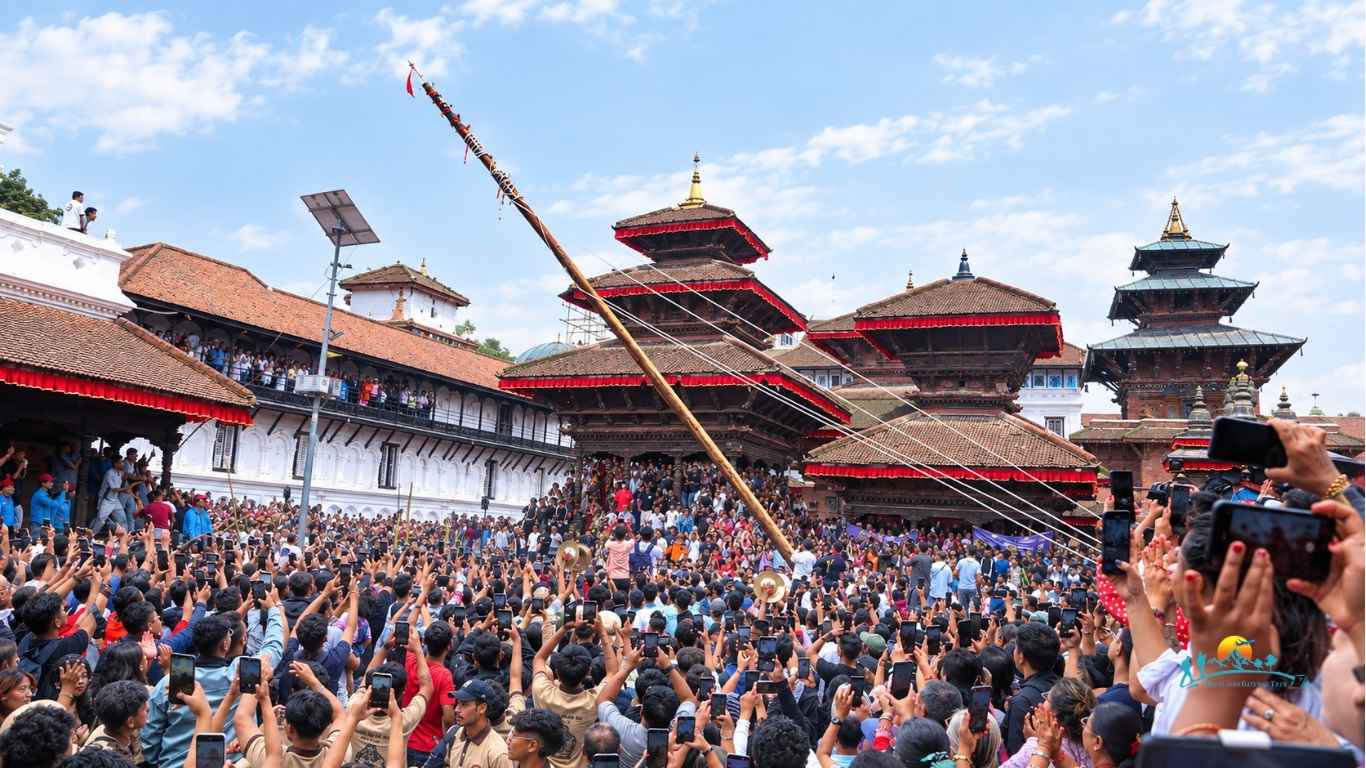
Indra Jatra is one of the biggest Newar festivals in Kathmandu that takes place over a few days and features worship, public processions, masked dances, ancestor worship and the festival of the Kumari chariot. The festival is a gathering of Buddhist and Hindu Newar communities in the old city, and has traditionally been attended by the majority of the urban population of Kathmandu.
The festival is also called Yenya, which is associated to Kathmandu and its festival in Newar language. It is not a festival that happens to be located in the old city, but it is part of the city’s cultural life.
At the centre of the celebration are several major traditions:
The Living Goddess Kumari is one of the most visible parts of the festival, but it is much larger than the Kumari procession alone.
The Indra Jatra Public holiday 2026 for Kathmandu Valley is Friday, September 25 (Ashoj 9). It is celebrated over a few days, with important rituals, chariot processions, masked dances and traditional ceremonies performed around Kathmandu Durbar Square and its environs.
On September 13 (Bhadra 28) Guthi Sansthan started the traditional forest trip to get the timber to make the ceremonial yoshin pole and on September 15 (Bhadra 30) the pole is carried to Bhotathity, and it is kept there till September 19 (Ashoj 3) when the pole is brought to Hanuman Dhoka.
The exact programme can change as the festival approaches, so visitors should check the latest notices before attending.
| Festival stage | Date in 2026 | Time | What Happens |
|---|---|---|---|
| Forest Journey | September 13 (Bhadra 28) | 9:53 A.M. | People of Manandhar Community and Nepal Army will go to Nala Bhaktapur to choose tree for Yoshin. |
| Tree Cutting | September 13 (Bhadra 28) | 8:47 P.M. | After Tree is selected then Tree cutting process will take place. |
| Entry of Yoshin into the city | September 19 (Ashoj 3) | 8:05 A.M. | Yoshin is brought to Hanuman Dhoka from Bhotahity. |
| The raising of the sacred Yosin pole with Indra Flag | September 23 (Ashoj 7) | 7:27 A.M. | From this day the Jatra begins. On this day the sacred Yosin pole with Indra Flag is raised by pulling and erecting Yosin. |
| Kumari Chariot Procession (Lower Area) | September 25 (Ashoj 9) | After 4:00 P.M. | The main day. On this day chariot of Kumari, Ganesh and Bhairav are pulled through the Lower Area of Kathmandu Valley. |
| Kumari Chariot Procession (Upper Area) | September 26 (Ashoj 10) | After 4:00 P.M. | On this day chariot of Kumari, Ganesh and Bhairav are pulled through the Upper Area of Kathmandu Valley. |
| Final day (Nanichaya) | September 30 (Ashoj 13) | After 4:00 P.M. | On this day chariot of Kumari, Ganesh and Bhairav are pulled through the Mid Area of Kathmandu Valley. Girls pull chariot on this day. |
| Lowering of the sacred Yosin pole with Indra Flag | September 30 (Ashoj 13) | 9:25 P.M. | After Nanichaya, Indra Flag is lowered by letting Yosin fall after this Jatra will be over for this year. |
It is celebrated to honor Indra, remember the deceased, maintain old Newar religious traditions and bring the historic city together through public rituals and processions.
The festival carries several meanings at the same time.
Indra has traditionally been associated with rain and the sky. There is also a story behind the festival and he is related to the flower search, being captured by the people in Kathmandu, and the arrival of his mother Dagin.
Rain has always mattered greatly to farming communities. The festival therefore carries an older connection with seasonal rain, crops and the hope for good harvests.
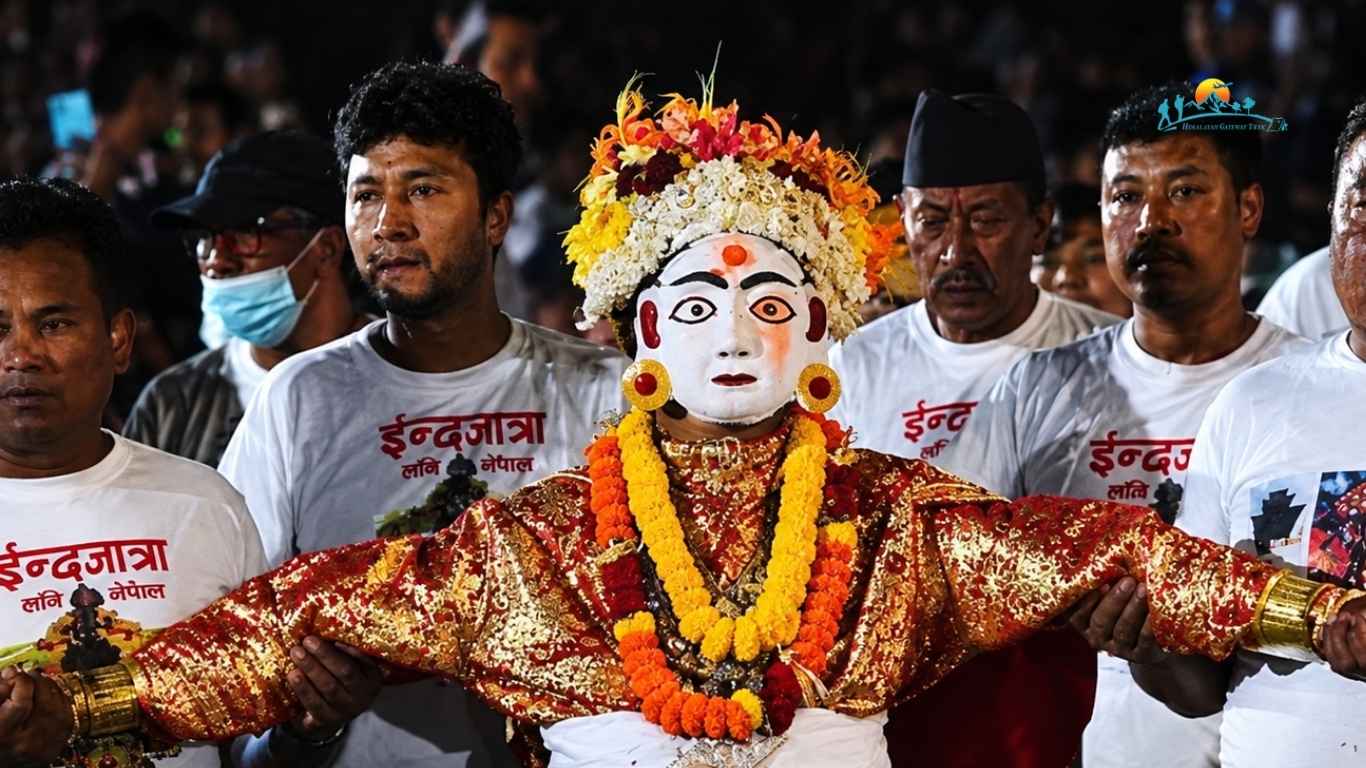
This Jatra also has an important connection with the dead.
At the festival, people participate in the Upaku Wanegu that involves carrying lights and strolling through certain sections of the old city to commemorate relatives who have passed away in the preceding year.
The Dagi (mother of Indra) is brought into the streets of Kathmandu on the first day of Kumari Chariot Procession after the chariot of the Kumari has come to Basantapur. The mourners of the deceased walk behind her, with their families holding the rice while they pray that their deceased loved ones will enter heaven.
This provides Indra Jatra with a more subdued and introspective expression that can be overlooked by those who savor just the music, masks, dances and chariots.
Indra Jatra requires the work of many local groups, families, performers, musicians and guthis. Each group has duties connected with particular rituals and performances.
That community work explains why the festival has remained a living part of Kathmandu for so long.
The figure, known as ‘Baumata’ is a long snake-shaped figure created using reeds and carried in the old streets of Kathmandu. Small traditional oil lamps called diyo are laid along its body, so that the snake can be seen as it glides through the dark streets. The structure is carried on long poles by local men and is taken around around the city as part of the festival.
During the southern chariot route or Kwaneya, Hyumata becomes a part of the festival. Another beautiful and lively aspect of the night’s celebration is the traditional light spinning ceremony that is conducted in the area.
Before the three main days of the Kumari chariot procession, Kumari, Ganesh, and Bhairav are taken to Taleju Chowk for a special puja. This takes place on the first day after the Indra flag is raised.
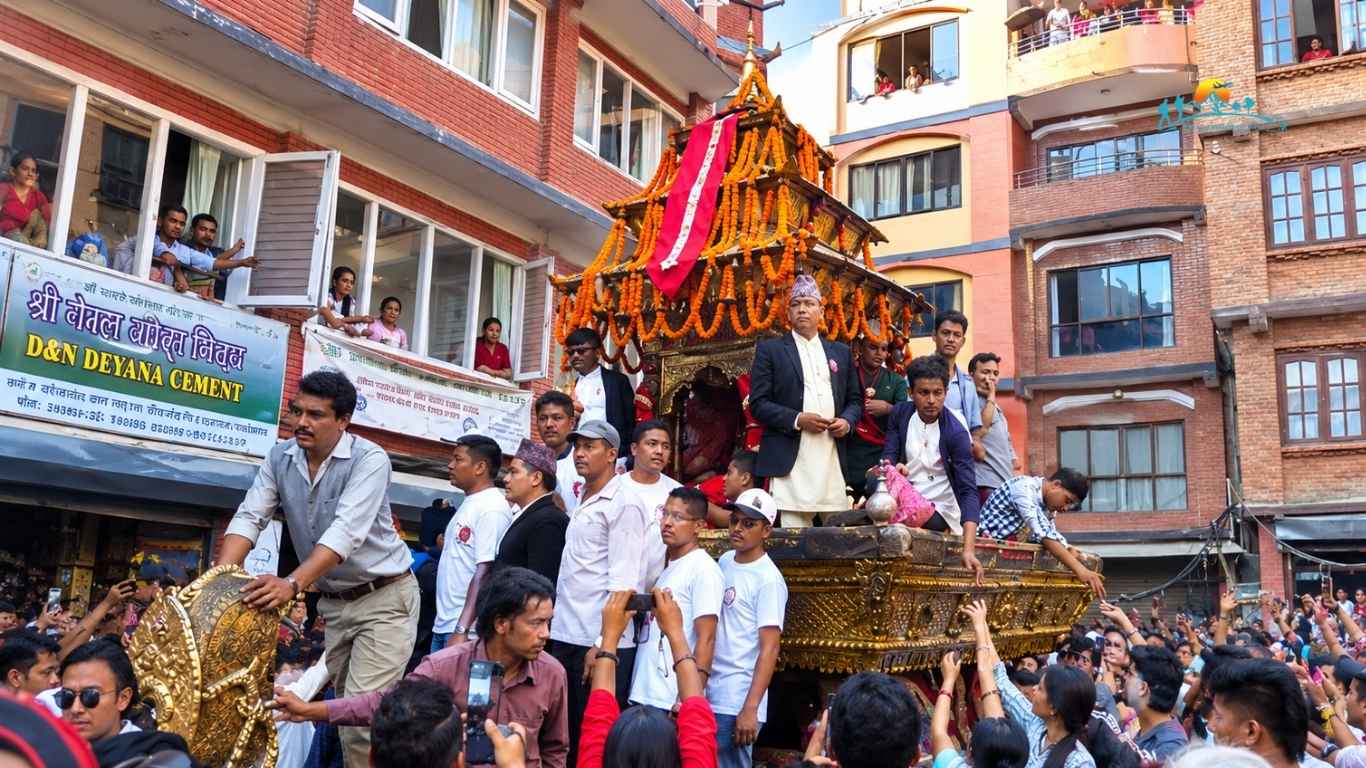
The first day of the Kumari chariot procession is Kwaneya. This day, the chariots of Kumari, Ganesh and Bhairav is taken through the lower part of Kathmandu.
The procession starts from the Basantapur and goes through Maru Tol, Jaisideval, Brahma Tol and Lagan. The chariots make their way back to Basantapur from Lagan via Hyumata where the traditional lights are spun at all three deities. Once the chariots have been taken back to Basantapur, the Kwaneya procession ends for the day.
This is the second day of the Kumari chariot procession, Thaneya. The chariots of Kumari, Ganesh and Bhairav move from Basantapur to Yetkha, Naradevi, Bangemuda, Asan, Indra Chowk, Makhan Tol and Hanuman Dhoka and come back to Basantapur.
Traditionally, the alcohol in Indra Chowk is poured out from the mouth of “Akash Bhairav” and given to the three deities. This ritual is repeated at Seto Bhairav, Hanuman Dhoka.
This day is also called as Yenya Punhi (main full moon day). Samay Baji (traditional feast of Newar) is prepared in different parts of Kathmandu Valley. The other places where the local people worship the deities are also visited with the transport of the chariots of Kumari, Ganesh and Bhairav. The celebrations include some masked dancers like Lakhey and in some areas blessed food or offering is given to the public as prasad.
Nanichaya is the third and last day of Kumari chariot procession. There is one popular legend that the additional day was added when a lady named Nanichaya resided in Kilagal and wished to be able to see the chariot from her own house.
On this day, the chariots of Kumari, Ganesh and Bhairav roll through the main areas of Kathmandu, such as Kilagal, Indra Chowk, Makhan, Hanuman Dhoka and Basantapur. One of the most special aspects of Nanichaya is the involvement of women and girls in pulling three chariots which make the procession memorable and a part of the festival.
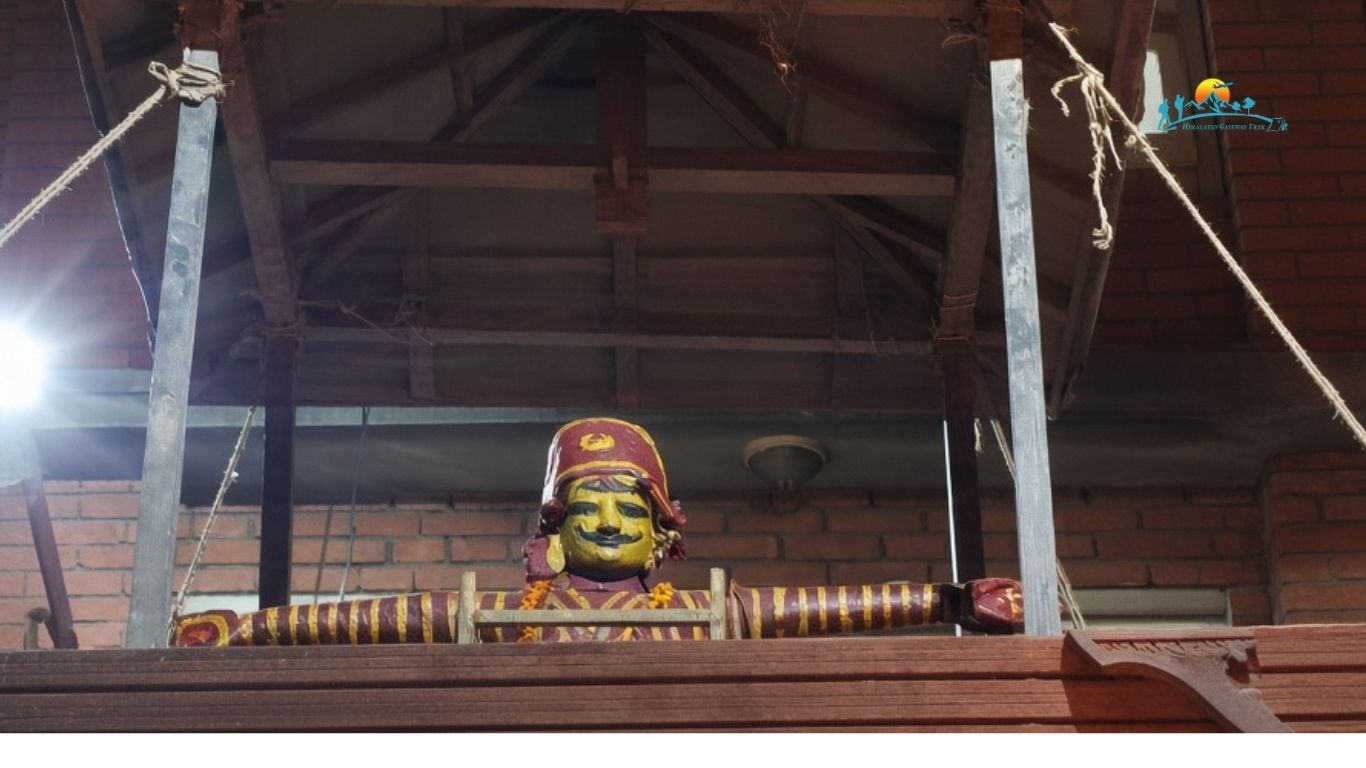
The best-known story says that Indra came down from heaven in human form to find a special flower for his mother.
The flower was Parijata, as per the Newar tradition. Indra went to look for it in the Kathmandu Valley, but people did not recognise him as a god and they captured him and tied him up with a pole.
Dagi, mother of Indra, went to Kathmandu in search of Indra as he didn’t return for a long period of time. She searched and searched, and finally discovered that he was taken prisoner and tied to a pole.
After that Dagi asked for Indra’s release and in returned people of Kathmandu Valley asked Dagi to take every people to heaven after death and also to spread a blanket of heavy morning fog and dew over the valley throughout the autumn and winter months to ensure a bountiful harvest for their crops and she promised and people of Kathmandu Valley released Lord Indra.
Indra Jatra is one of the oldest of the traditional festival of Kathmandu. In Newar tradition, the festival was started by the 10th century King of Kathmandu Gunakamadeva. Believed to have been used by the people of the old Kathmandu Valley for their religious and cultural practice.
Over the centuries, this Jatra grew into an important festival for both Hindu and Buddhist Newar communities. The tradition has continued through generations, making it an important part of Kathmandu’s cultural history.
Jaya Prakash Malla, King of the Malla Dynasty (1657-1792), in the mid-18th century, about 1756 AD, brought significant changes in Yenya. He introduced the festival Kumari Jatra, and also added three special chariots to it.
The three chariots carry the living representatives of Ganesh, Bhairav, and Kumari. The Ganesh chariot goes first, followed by Bhairav, and the Kumari chariot, which is the largest, follows last. The three chariots are pulled through the old streets of Kathmandu during the festival.
This change made Indra Jatra even more important and colorful. It also helped make the chariot processions one of the most famous parts of the festival today.
This Jatra has always been associated with the royal family of Kathmandu. The festival was held around Hanuman Dhoka Palace, where the kings participate in religious rituals and receive blessings from the deities. The purpose of these traditions was to display the authority and divinely appointed nature of kings.
The most significant event was on September 26, 1768. Meanwhile, Malla King of Kathmandu and her kingdom were enjoying, Prithvi Narayan Shah of Gorkha conquered Kathmandu without any resistance. Once he has conquered the palace, he was given tika and blessings by the Living Goddess Kumari. It was an important event where the Shah Dynasty and unification of Nepal began.
Nepal later became a republic in 2008, ending the monarchy. Today, the President of Nepal visits Basantapur and receives blessings and tika from Kumari. The tradition has continued even though Nepal’s system of government has changed.
The story of Kumari is closely associated to the old king of Malla of Kathmandu. Taleju Bhawani Temple was built in the 16th century by King Mahendra Malla and Taleju became the main goddess of Malla rulers. Later she became closely associated with the Kumari tradition of a young Newar girl as a living representation of the goddess.
According to a popular legend, King Jayaprakash Malla was very close to Goddess Taleju. But when the goddess went out of the palace, she informed the king that she will come back as a young girl of the Newar community. Then the king looked for the girl and the practice of worshipping a young girl as the Living Goddess Kumari was continued throughout the generations.
The Kumari is a young girl who is worshipped as a living goddess within the Newar tradition. During the Indra Jatra, her public appearance on the chariot is one of the festival’s most awaited events. Nepal Tourism Board describes Kumari as the centre of the celebration, while the festival itself includes many other deities, dances and rituals.
For visitors, seeing Kumari during the procession is a rare opportunity because her public appearances are limited.
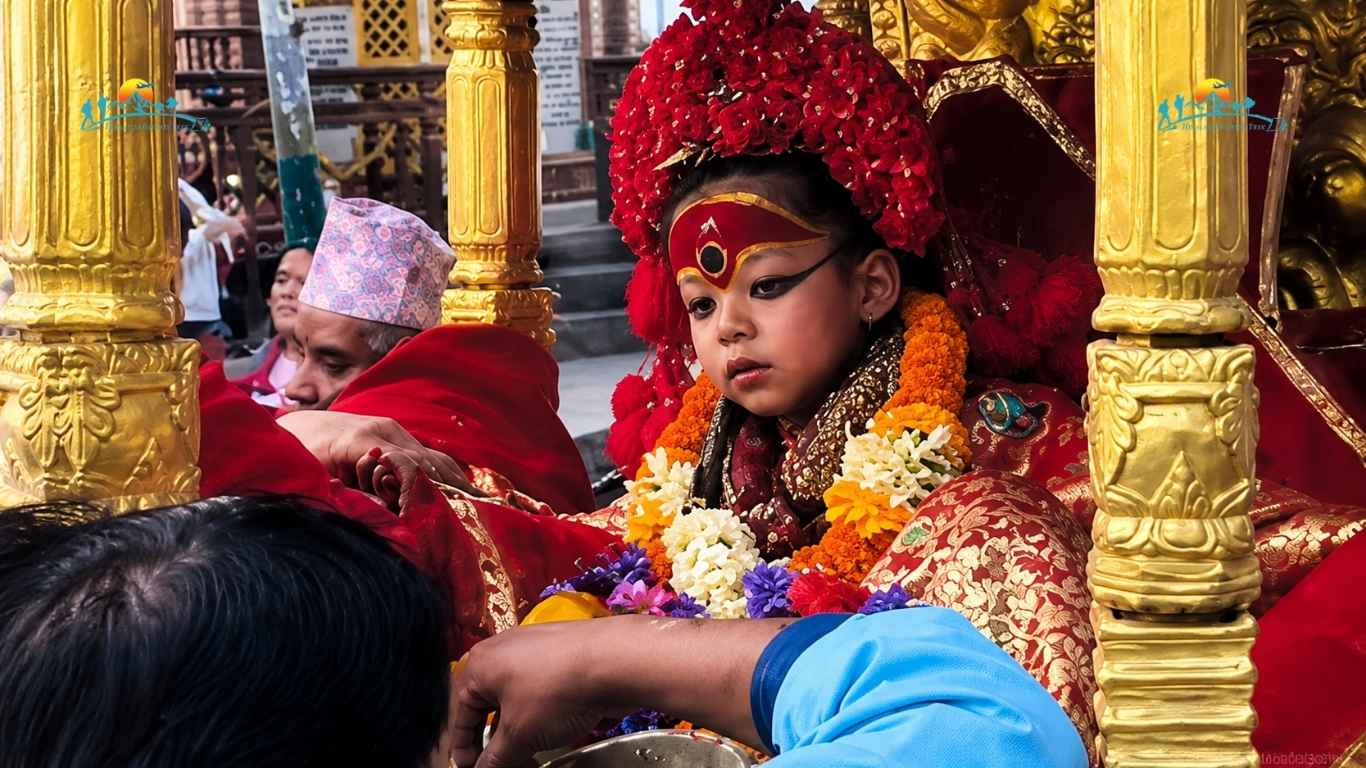
Aryatara Shakya, from Itumbahal, Kathmandu, became the new Royal Kumari of Kathmandu on September 30, 2025, at just two-and-a-half years old. She took over the role of Kumari from Trishna Shakya who had been in the role for eight years before she matured.
After a traditional selection process made by senior priests and astrologers among the Shakya Buddhist community, Aryatara was selected. She has been installed in the historic Kumari Ghar at Basantapur Durbar Square and her upbringing is provided by private tutors with the exception of some important religious processions.
Indra Jatra 2026 will be Aryatara Shakya’s first Jatra as the Living Goddess of Kathmandu.
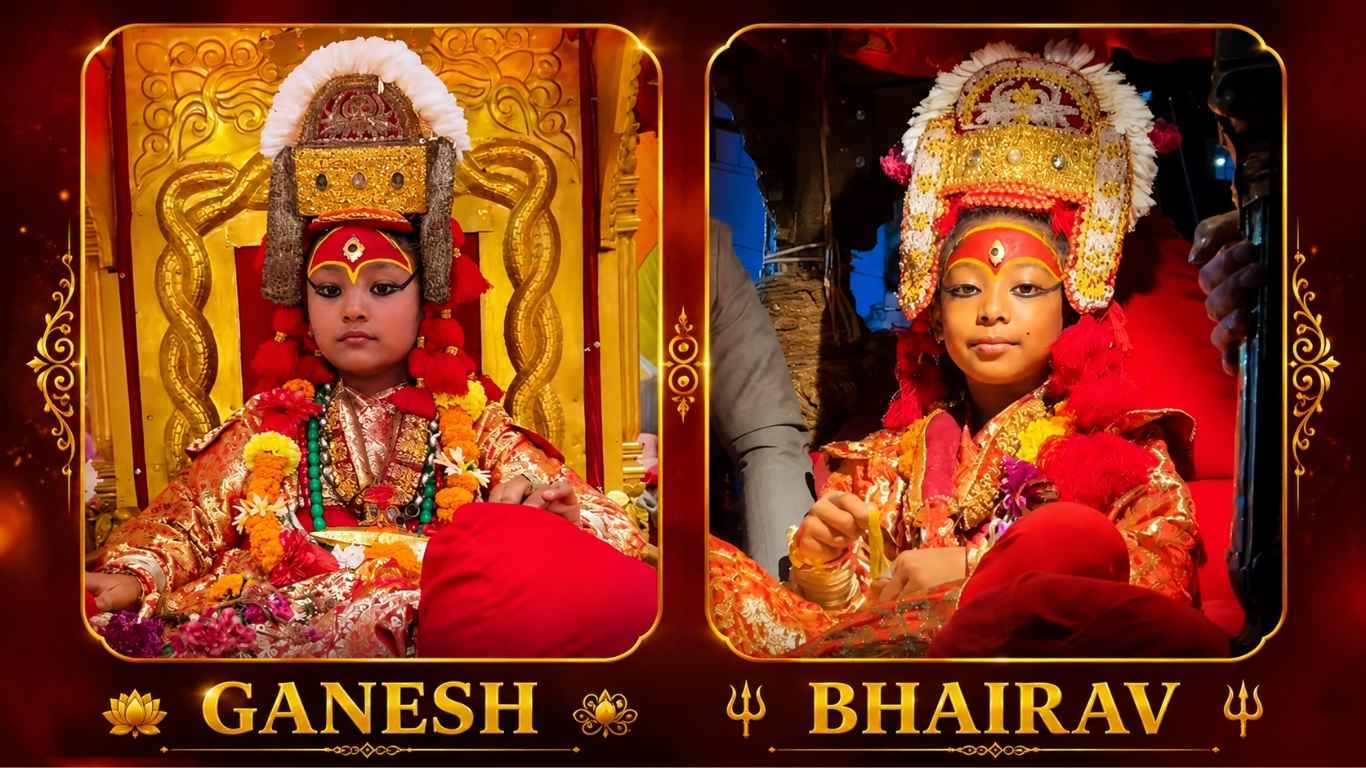
In Kathmandu, the Royal Kumari is venerated not only as the living form of Kathmandu’s goddess, but also as that of two young boys who are thought to be the living images of the gods Ganesha and Bhairav. They are selected using traditional rituals from the newar Shakya or Vajracharya community. Ganesh is a symbol of wisdom and good fortune, and Bhairav is a symbol of Lord Shiva’s protective and powerful aspect.
Unlike the Kumari, the two boys continue to live with their families and attend school. During the Jatra, they wear traditional clothes and jewelry and are carried in their own chariots. Ganesh’s chariot leads, Bhairav’s follows, and Kumari’s comes last.
The boys keep their divine status until puberty or their coming-of-age ceremony, known as Kaitapuja or Bratabandha. After that, a new child is chosen to continue the tradition.
Women began pulling Kumari’s chariot as a trial in 2011, and from 2012 women were allowed to pull all three chariots.
Women had not previously been allowed to pull the chariots. After the 2011 trial, the organizers found that the process was disciplined and well managed, and women were permitted to pull the Kumari, Ganesh and Bhairav chariots from 2012 onward.
The change has become a visible part of modern Indra Jatra. On Nanichaya, women gather around the ropes and take part in pulling the chariots through the old streets. The scene is especially popular with photographers because it combines a long-standing ritual with a newer chapter in the festival’s public participation.
There are a lot of characters in Indra Jatra that may confuse first timers. The festival is easier to understand if one knows who they are.
Indra is at the center of the festival. He is associated with rain, the heavens and the traditional story behind the celebration.
The principle deities of the Jatra are the living Goddess Kumari, and the living gods Ganesh and Bhairav. Chariots are pulled through the streets of Kathmandu during the festival in three main stages the upper area, the lower area and the last one called Nanichaya.
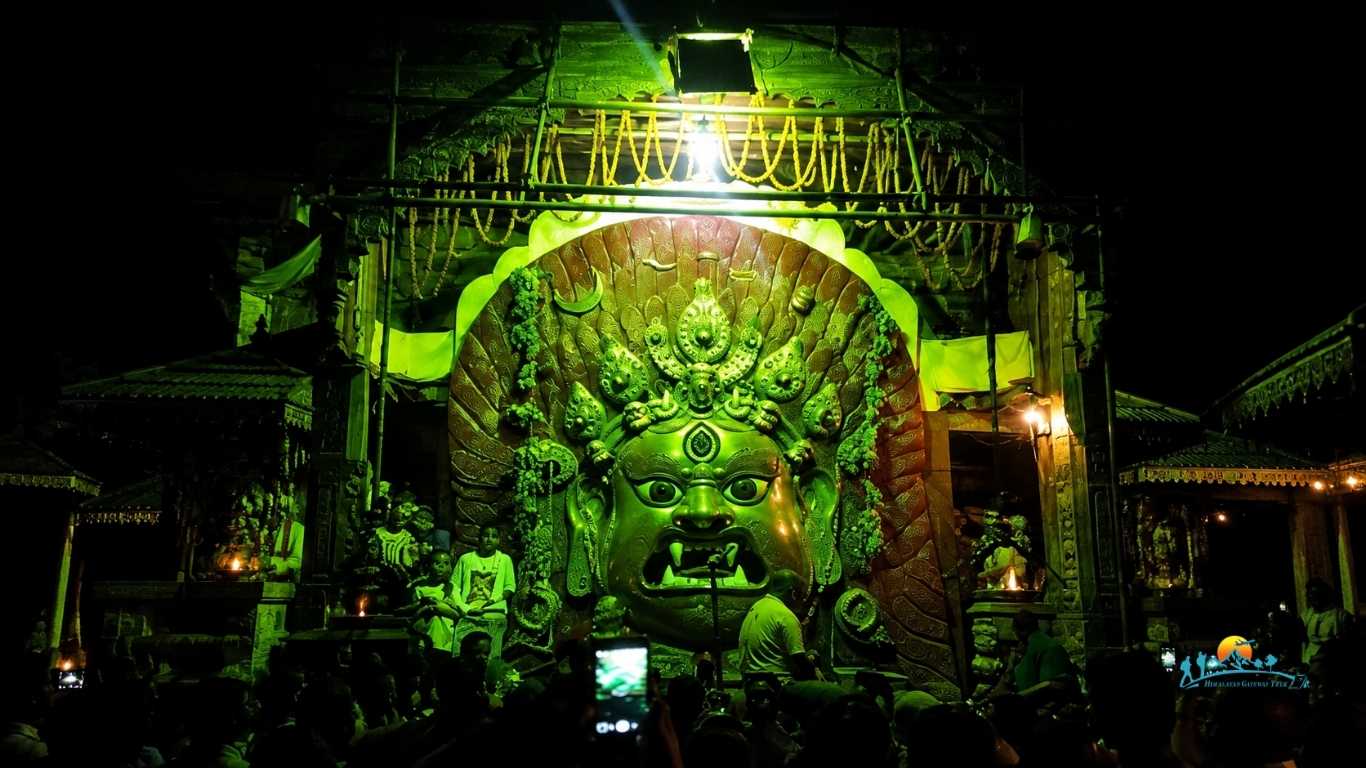
Seto Bhairav, the White Bhairav, is displayed in Kathmandu during the festival.
One of the most famous traditions involves local alcohol being released through a channel associated with the Bhairav mask. Crowds gather around the display to receive it as a form of blessing and prasad.
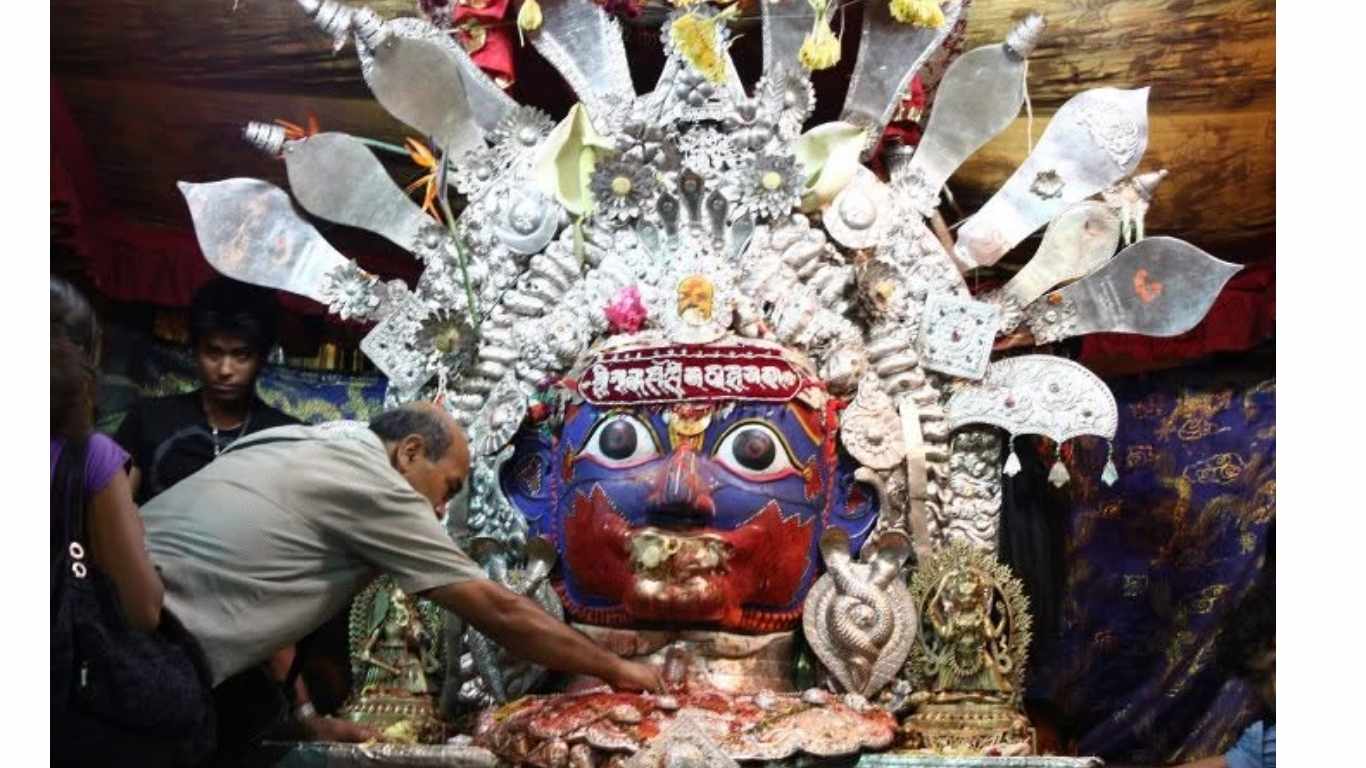
Akash Bhairav or Wonga Aaju in Newari language is displayed around Indra Chowk.
The huge Bhairav head draws large crowds and provides one of the most recognizable scenes from this Bhairav mouth also local alcohol is released.
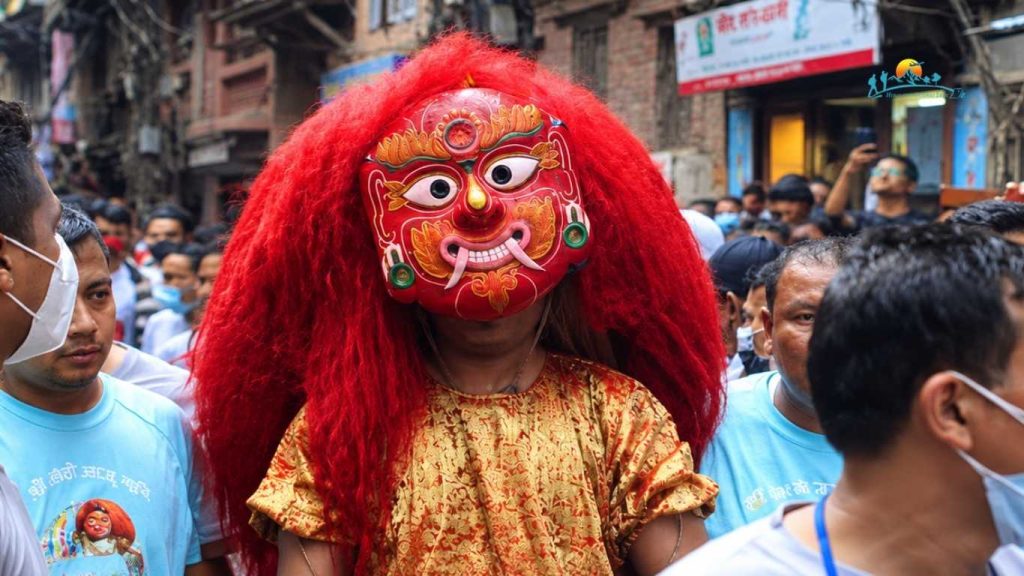
Majipa Lakhey is one of the festival’s best-known masked dancers. The performer wears a large red mask and moves through the streets accompanied by traditional music.
According to local legend, Lakhe had a girlfriend in Majipath. He would visit her at night and leave before sunrise. After some time, people discovered his visits and decided to catch him.
One day, they managed to capture Lakhe and would not let him go unless he made a promise. Lakhe agreed that he would return every year and perform his traditional dance during the festival. Only after he made this promise did the people set him free.
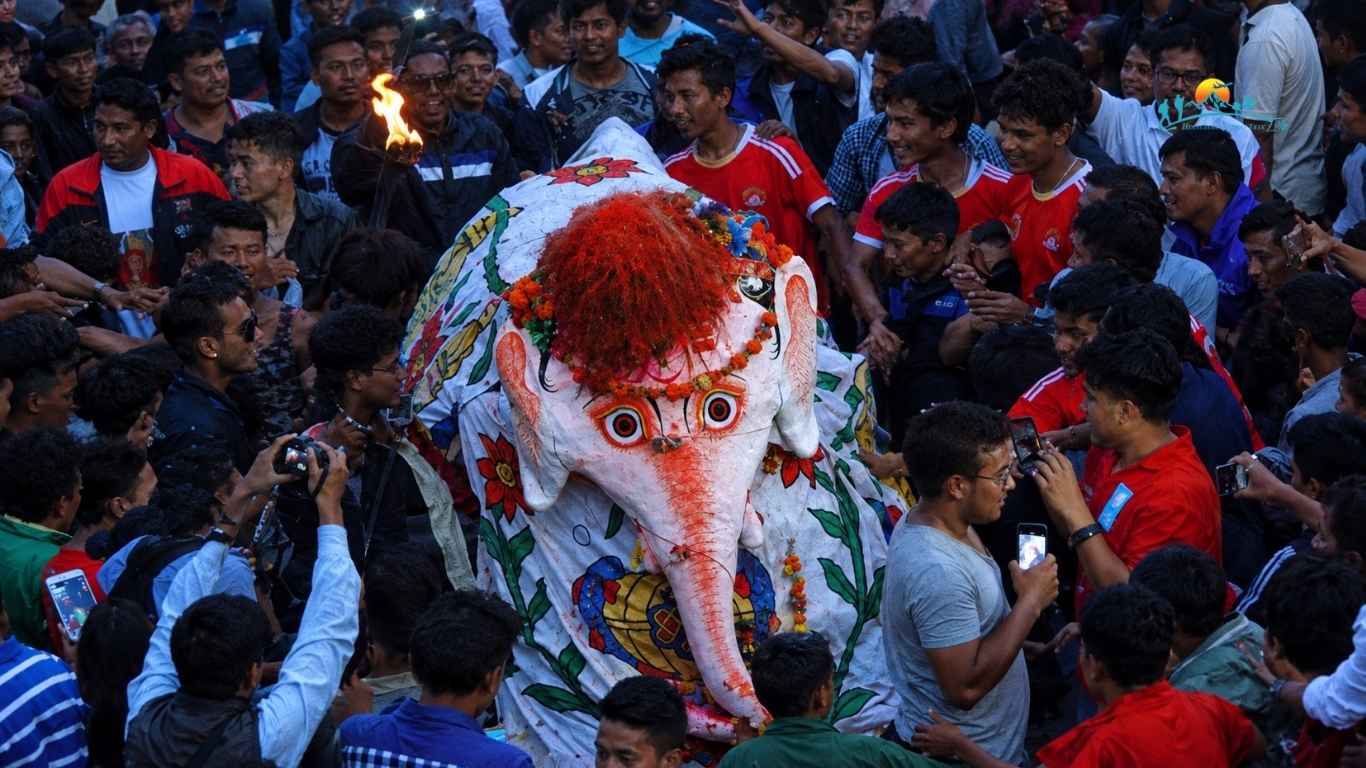
Pulu Kisi is a masked elephant figure.
According to the traditional story, Indra came to Kathmandu with his elephant named Airavat and he left his elephant at a place called Kilagha. The area became known for keeping elephants and was called Hatti Godhar, which means “elephant stable” or “place where elephants are kept.
After people captured Lord Indra, he could not return to the place where his elephant was kept so his elephant which is called Pulu Kisi in Newari started searching for Indra. The character moves through the streets of Kathmandu to the sound of Dha Baja (Traditional Newari Drum) searching for Indra.
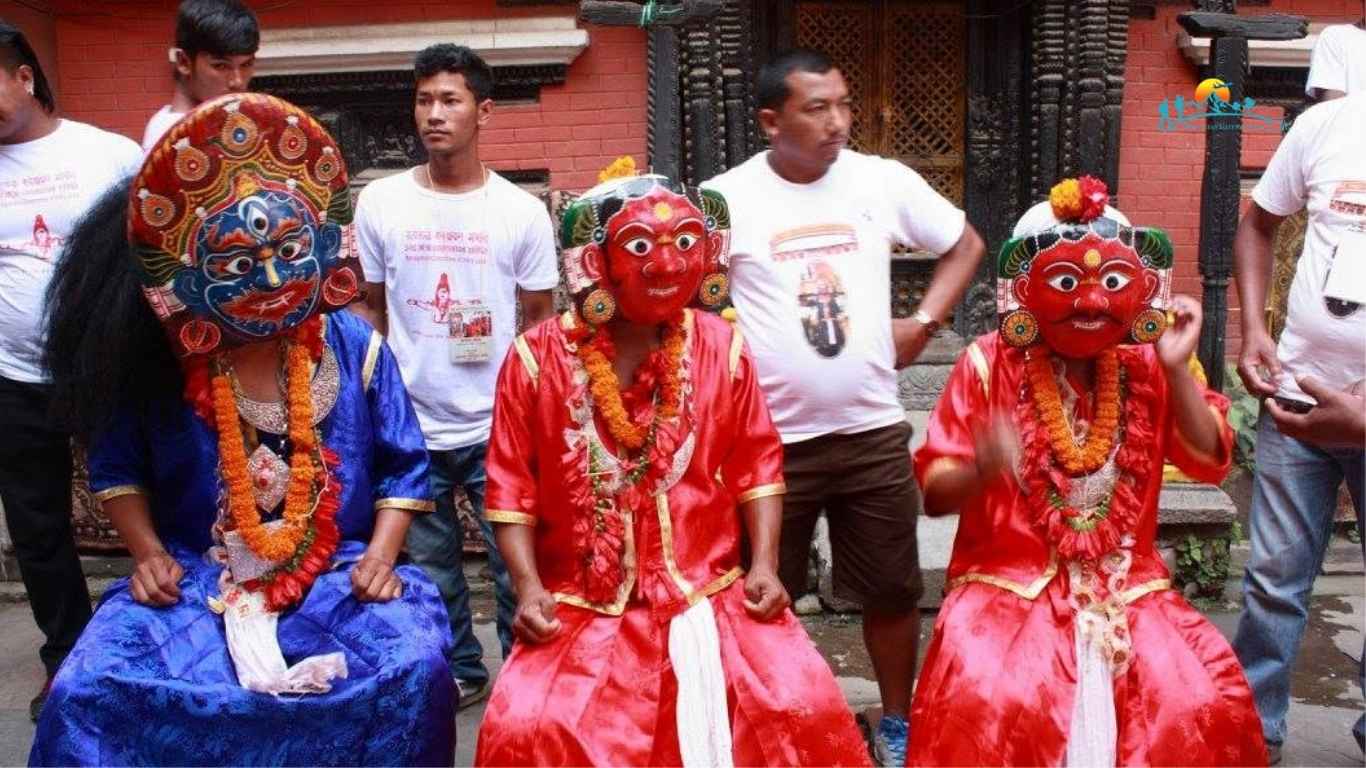
This is one of the biggest masked dance after lakhe and Pulu Kisi. This dance is brought from Halchowk for this Jatra. In this dance, there are three deities.
Together, the three figures make Sawa Bhakku a powerful and striking performance, combining religious devotion, traditional masks, music, and dance.
Devi Dance is an ancient and sacred masked goddess dance performed every year during Indra Jatra in Kathmandu, Nepal. The dance begins at Natyasor Temple in Kilagal (Kilagha) Tole and is traditionally considered the first dance performed after the Yoshin (Lingo) is raised, marking the beginning of the festival.
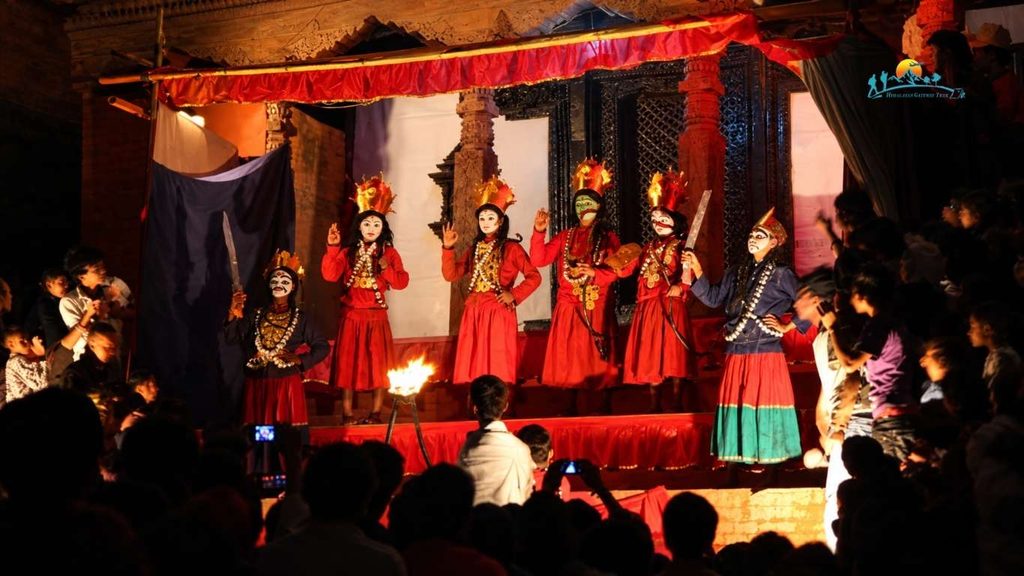
Dashavatar presents the ten incarnations of Vishnu through performance. It is shown near Kumari ghar throughout all eight days of Indra Jatra.
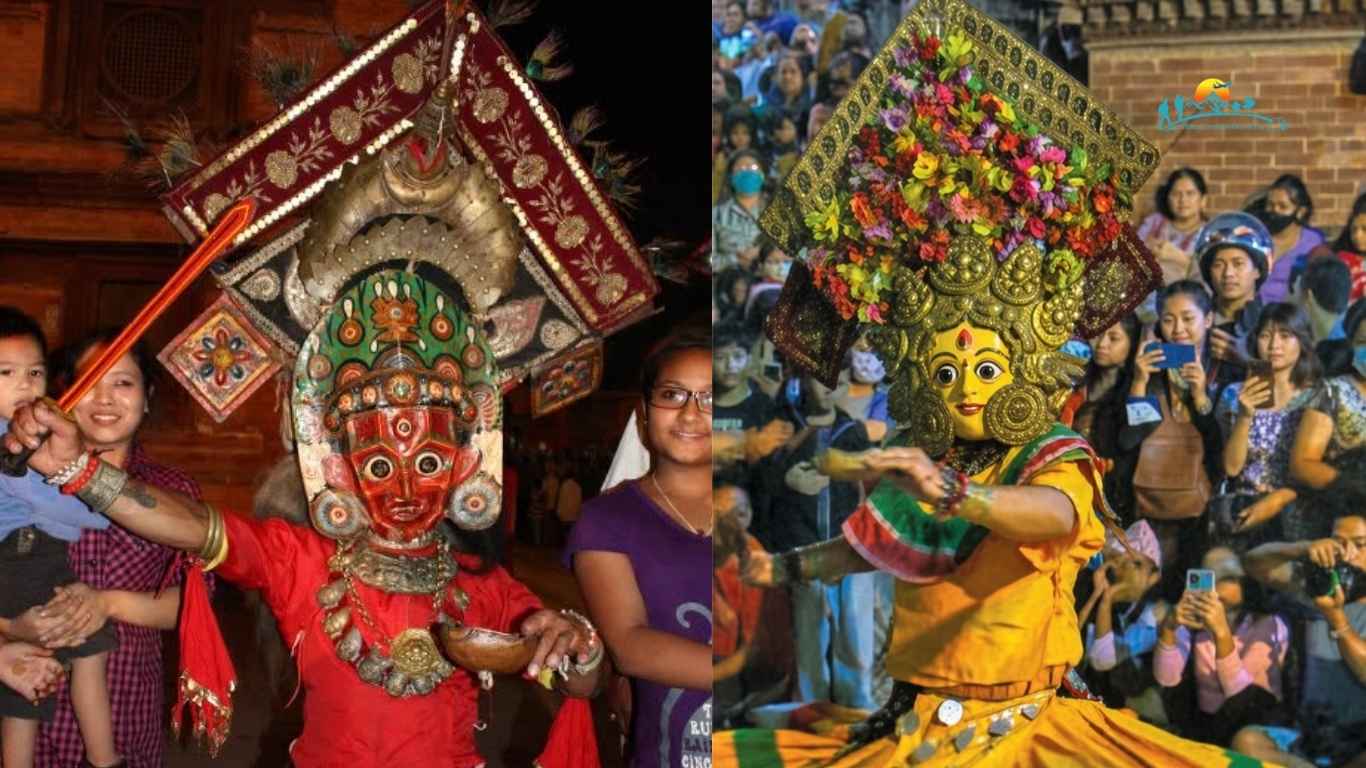
The Mahakali Dance of Bhaktapur, also known as Mahakali Pyakhan or Devi Pyakhan, is an ancient and sacred masked dance. It represents Goddess Mahakali and other divine figures fighting evil forces. The dance is brought from Bhaktapur to Kathmandu, where it is performed during all eight days of the Jatra.
The famous alcohol ritual of Seto Bhairav, known as Hathu Hayegu in Newari, takes place during all eight days. During the festival, local alcohol called Ayla is offered to people as a blessing or prasad.
Behind the large mask of Seto Bhairav is a big traditional clay vessel, known as a ghyampo, which is filled with Ayla. The alcohol flows through a pipe placed inside the mouth of the mask. People gather around Seto Bhairav and drink the alcohol directly from the pipe as a blessing.
There is also a special rule during this ritual: people must not touch the pipe with their hands. They must drink the Ayla directly from the pipe without touching it. This unique tradition is one of the most popular and exciting parts of Indra Jatra.
Food is an important part of the festival because Indra Jatra is also a time when families and communities share traditional Newar dishes.
Samay Baji is a traditional Newar food platter commonly served during festivals and family gatherings.
A plate may include:
The exact combination varies from one household to another.
For visitors, Samay Baji offers a much better understanding of festival food than simply looking for restaurant versions of “Nepali food.”
Newar communities also have long traditions of fermented drinks such as aila and other local beverages.
Visitors should remember that traditional drinks can be strong and should be consumed carefully.
Indra Jatra brings together the traditions that make old Kathmandu special, from the worship of Indra and Kumari to Bhairav, masked dances, chariot processions, ancestor rituals and Newar music. For visitors, the festival offers much more than colorful chariots and performances. Every street, shrine and procession carries a part of Kathmandu’s living culture.
In 2026, September 25 is the main public holiday in Kathmandu Valley, but the celebration continues across several days. The best way to experience it is to watch with respect, understand the meaning behind the rituals and give local communities space to carry out traditions that have been passed down through generations.
Indra Jatra is celebrated to honor Lord Indra, the god of rain and harvest, thanking him for bountiful crops. According to legend, it commemorates Indra’s descent to Kathmandu to fetch Parijat flowers, where locals bound and honored him.
Rituals begin in the early morning around 8:00 AM with auspicious traditional ceremonies at Kathmandu Durbar Square. However, the iconic chariot processions of Goddess Kumari, Ganesh, and Bhairav typically launch in the afternoon between 2:00 PM and 4:00 PM.
Jatra officially begins at Kathmandu Durbar Square (Hanuman Dhoka) with the ritual hoisting of the Yasin pole. The eight-day festival ends at the same square when the pole is taken down and immersed in the sacred Bagmati River.
In Nepali, Indra Jatra is written as इन्द्र जात्रा. However, in Nepal Bhasa (Newari), it is called Yenya (येँयाः). ‘Yen’ translates to Kathmandu and ‘Ya’ means celebration, making its literal name ‘the local festival of Kathmandu city.’
Indra Jatra, locally known as Yenya, is Kathmandu’s largest street festival celebrated by the Newar community. It pays tribute to Lord Indra, god of rain and harvest, featuring vibrant chariot processions, masked dances, and cultural displays.
It is celebrated annually in September (Bhadra/Ashwin in the Hindu calendar). The date varies each year according to the lunar cycle, beginning on the twelfth day of the bright fortnight of the month of Bhadra.
The festival honors Lord Indra, the deity of rain, thanking him for rich agricultural harvests. According to legend, Indra descended to Kathmandu to pick Parijat flowers, was captured, and later revealed his divine identity to locals.
Indra Jatra is primarily celebrated in the heart of historic Kathmandu, centered around Kathmandu Durbar Square (Hanuman Dhoka). Celebrations also take place across inner Newar settlements in Patan, Bhaktapur, and surrounding areas in Kathmandu Valley.
It lasts for eight days. The festival officially begins with the raising of a ceremonial wooden pole called the Yasin at Kathmandu Durbar Square and concludes when the pole is lowered and taken to Bagmati River.
Kumari is a young prepubescent girl worshiped as the living incarnation of Goddess Taleju. During Indra Jatra, she rides a grand chariot through Kathmandu’s streets, blessing citizens, heads of state, and visiting international tourists
Kumari Jatra is an integral part of Indra Jatra, started by King Jaya Prakash Malla in 1756. It features the chariot procession of Living Goddess Kumari alongside chariots of living deities Lord Ganesh and Lord Bhairava through Kathmandu.
Indra Jatra features prominent Newar masked dances, including the energetic Majipa Lakhey (demon dance), Sawa Bhaku, and Mahakali dance. Costumed performers dance to traditional drum beats across Kathmandu’s historic square and old street quarters.
Massive, fierce masks of Swet Bhairav and Akash Bhairav are unveiled publicly only during Indra Jatra. Traditional local rice beer and liquor are piped through Swet Bhairav’s open mouth to bless gathering devotees and spectators.
Samay Baji is a traditional Newari ritual feast consisting of beaten rice, roasted meat, black soybeans, ginger, garlic, and local alcohol. It is offered to deities and shared among families and visitors for good fortune.