

Best Time to Visit Bhutan: Month-by-Month Guide
The best time to visit Bhutan depends on what you want from the trip, because spring brings rhododendron flowers and…
 Himalayan Gateway Trek - On
 The Living Goddess Kumari is one of the most unusual and revered religious practices in Nepal. A young girl from the Shakya community of Newars in Kathmandu becomes the embodiment of the goddess Taleju and is worshipped by both the Hindu and Buddhist community. She resides at Kumari Ghar in Kathmandu Durbar Square, shows up on major festivals and grants blessing to the devotees during specific days. This tradition is still observed today.
Kumari is generally associated with a young girl or an unmarried girl. However, in Nepal the title has a lot more of religious significance. The child is not just a significant cultural figure. While she is Kumari, her devotees regard her as a god, a Deity.
For visitors, seeing the Kumari can be a memorable part of a Kathmandu visit. For the Newar communities of the Kathmandu Valley, however, the tradition is much more than a tourist attraction. It connects religion, festivals, royal history, family traditions, architecture, and the daily life of a child. Understanding those links makes a visit to Kumari Ghar far more meaningful.
The Living Goddess Kumari is a girl who is pre-pubescent who has been chosen from the Newar Shakya community and is traditionally worshipped as an earthly representation of the goddess Taleju Bhawani. In Kathmandu, the Royal Kumari of Kathmandu Valley resides in Kumari Ghar of Basantapur and is revered by both the Hindu and Buddhist devotees.
It is also one of the main concepts of the tradition to emphasize that the goddess manifests herself in a young girl before puberty. When the normal requirements for the end of her term are fulfilled, another child is chosen.
The word Kumari is of Sanskrit origin and is generally used to refer to a young girl or unmarried girl. The word has a special meaning in the religious tradition of Nepal, the chosen child is considered as the human form of a goddess for a brief period.
The title also highlights one of the central ideas of the tradition: the goddess appears in a young girl before puberty. Once the traditional conditions for the end of her tenure are reached, another child is selected.
The Kumari is known as living goddess because the devotees do not worship only a statue or image of her. They revere a living child who is believed to be the presence of the goddess in tradition.
Not all of the Nepalis know about it in the same manner. There are variations in religious beliefs and the tradition of the Kumari emerged over a number of layers of Hindu and Buddhist practice in the Kathmandu Valley.
The title is also a reference to the temporary divinity of the Kumari. While she is in power, she is treated like a god; rituals and offerings are made to her. Her duty remains till old age, when traditional conditions are met, at which point, another young girl is chosen to replace her.
The answer is not simply one or the other.
The Royal Kumari is a Buddhist Newar from the Shakya community, and the goddess she represents, is closely related to the Hindu goddess Taleju Bhawani. Both Hindus and the Buddhists venerate the Kumari. According to the Nepal Tourism Board, Kumari is a figure that is adored by both religious groups in Nepal.
This is because it’s a common worship and for this reason, the Kumari is still significant for Kathmandu’s religious community. The Kumari tradition is an example of the intermingling of Hindu and Buddhist beliefs in the Kathmandu Valley. Her worship is a coming together of religions that have evolved over the centuries side by side, and her importance is important to both.
The Kumari is not just a part of any one religion; for many devotees it embodies divine feminine power. This is a common tradition and is the reason why the Kumari remains a respected figure in the cultural and religious life of Kathmandu.
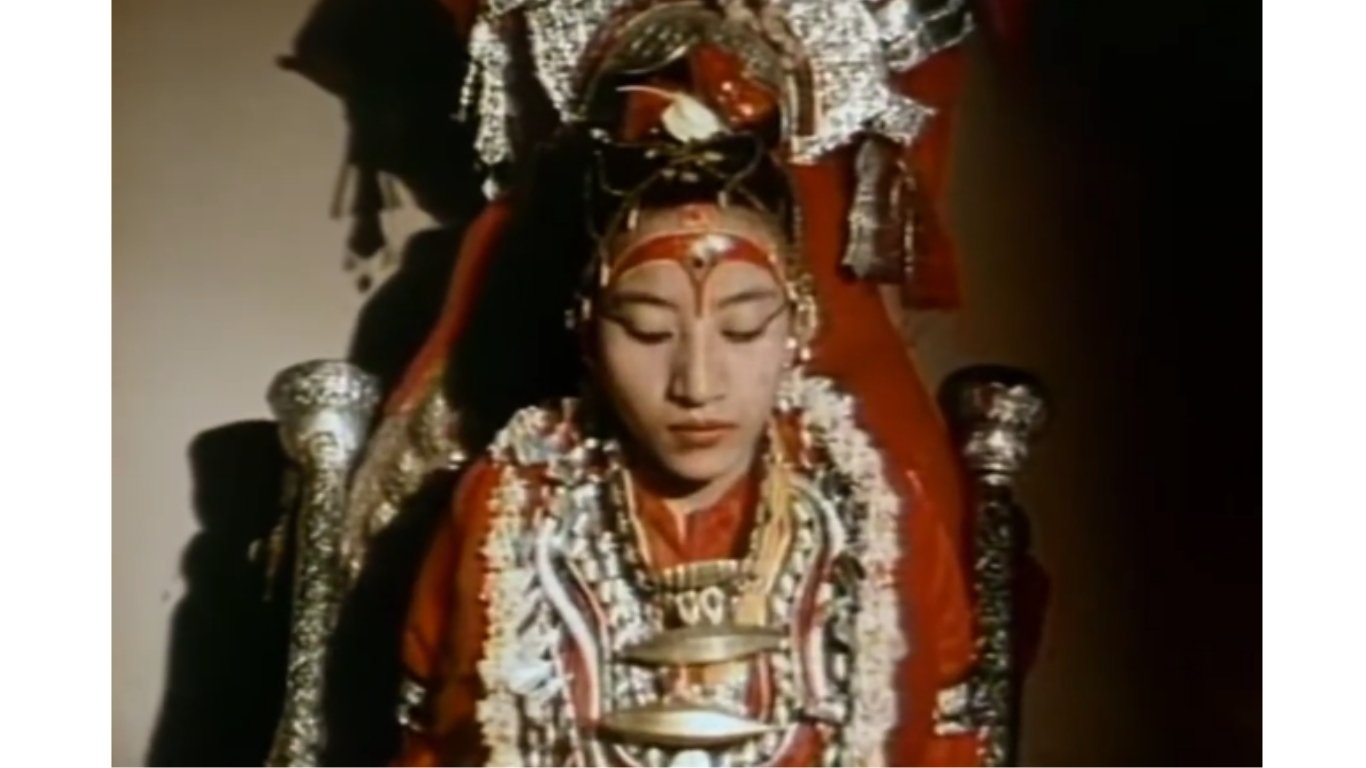
The modern Kumari system developed from older traditions of Kumari worship in Nepal. The concept of virgin worship in Nepal is not a new one, as various forms of it existed prior to the current royal Kumari tradition. The exact date and ruler in which the current institution was formed is not known and the dates and rulers vary according to different historical accounts.
One widely known account connects the royal Kumari tradition with the Malla period of Kathmandu.
Kumari worship is older than the modern royal Kumari system, with various forms of virgin worship existing in Nepal before the current tradition developed. The exact date and ruler associated with the beginning of the current institution are not known, and different historical sources give different accounts.
Because sources differ, it is best to distinguish historical records from religious legends.
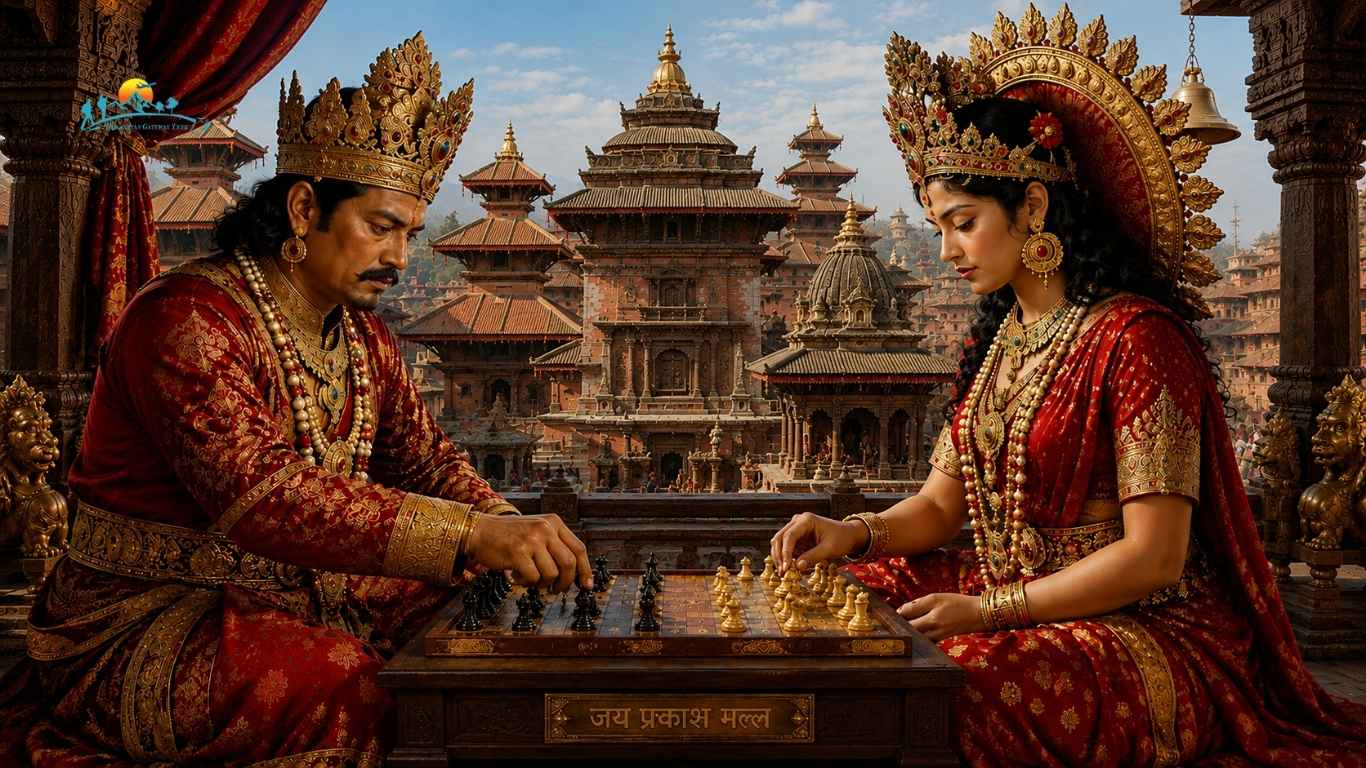
According to one of the most well-known stories, Goddess Taleju would visit the King, King Jaya Prakash Malla in human form and play a game with him. The king displeased the goddess and she vanished from the scene, according to the legend. The king later asked the goddess for forgiveness, and Taleju came in his dream.
Then she told him that he was to continue his worship by means of a young girl to represent her. This story still plays an important role in the explanations of the genesis of the Royal Kumari tradition. It is not possible to prove the same way as the construction date of Kumari Ghar, but it is a religious legend.
During the reign of the Mallas and Shahs, the relationship between the Kumari and the monarchy came to play an important role. The old royal system was closely associated with the Royal Kumari. Her blessing was given to Kings, and the relationship between the Kumari and the ruler was of a religious nature. This tradition has continued since the Shah dynasty came into power from the Malla rulers.
Even after Nepal was declared a republic in 2008, the Kumari tradition went on. Indeed, the religious role survived the political change because the tradition is geared to the cultural and religious life of the Kathmandu Valley, and not just to the monarchy.
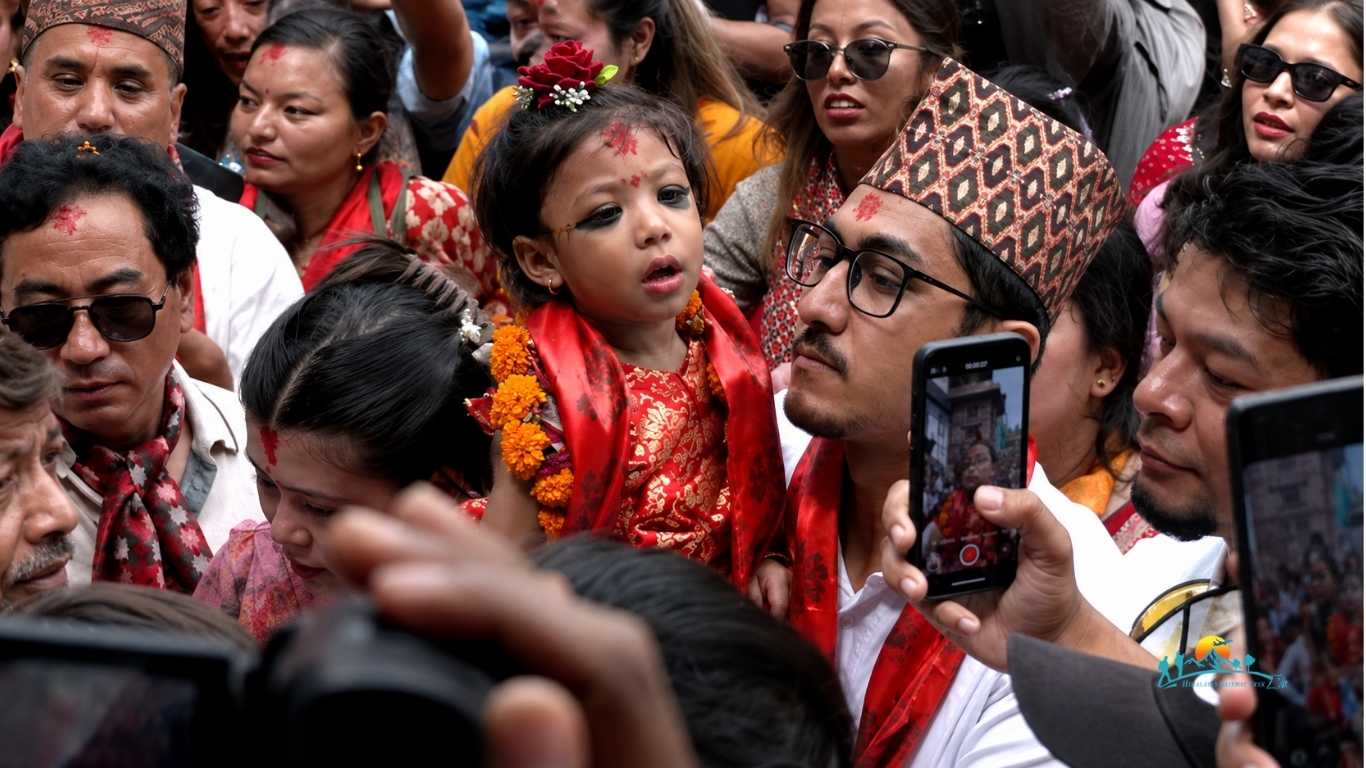
The selection of the Living Goddess Kumari is based on religious traditions and takes place in several steps. People are selected from the Shakya community and tested for qualities of perfection including health, physical appearance, purity and fearlessness, and are expected to possess qualities related to these standards.
The exact process can vary between sources and locations, so the following description focuses on the Royal Kumari of Kathmandu.
The Royal Kumari is traditionally selected from the Shakya clan of the Newar community. The Newars are one of the historic communities of the Kathmandu Valley, and the Shakya community has a strong Buddhist heritage.
Candidates are very young children. In recent reports, it has been stated that the age of the Kathmandu Royal Kumari is between two and four years of age. Aryatara Shakya was 2 years-8 months-old when she got selected 2025.
The child must also meet traditional requirements before she can be accepted.
The selection is not based on a simple public competition.
The Shakya Mahavihar Association requests traditional monastic courtyards in Kathmandu to suggest girls who are eligible for selection. Prior to the final selection process many bahals will be approached for nominations.
This shows that the process involves the community as well as religious authorities.
Traditional selection includes strict attention to the girl’s physical condition.
The sources mention that the requirements include healthy skin, appropriate eyes and hair, healthy teeth, and body free of marks and injuries. It’s not just for looks. These are attributes of a religion that aligns the child’s body with purity and the divine.
Astrology also forms part of the traditional process. Reports on the 2025 selection mention involvement from the Panchang committee, which deals with the Nepali calendar and auspicious timing. The selection process also includes religious authorities and people connected with Kumari Ghar.
Fearlessness is one of the most talked-about parts of the Kumari selection.
The traditional accounts tell of a dark or sinister test to see if the candidate is able to keep his cool. The concept of fearlessness continues to be highlighted in modern publications. Candidates are advised by AP that they need not be scared of the dark.
There are often embellished stories about the final test on the Internet. A responsible article should provide an explanation of the religious meaning without reverting to make the stories into facts.
Once a girl meets the traditional requirements, religious authorities formally select her as the new Kumari. She is then taken to Kumari Ghar and prepared for the traditional ceremonies that mark the beginning of her tenure as the Living Goddess. Her family and community also play an important role in this transition.
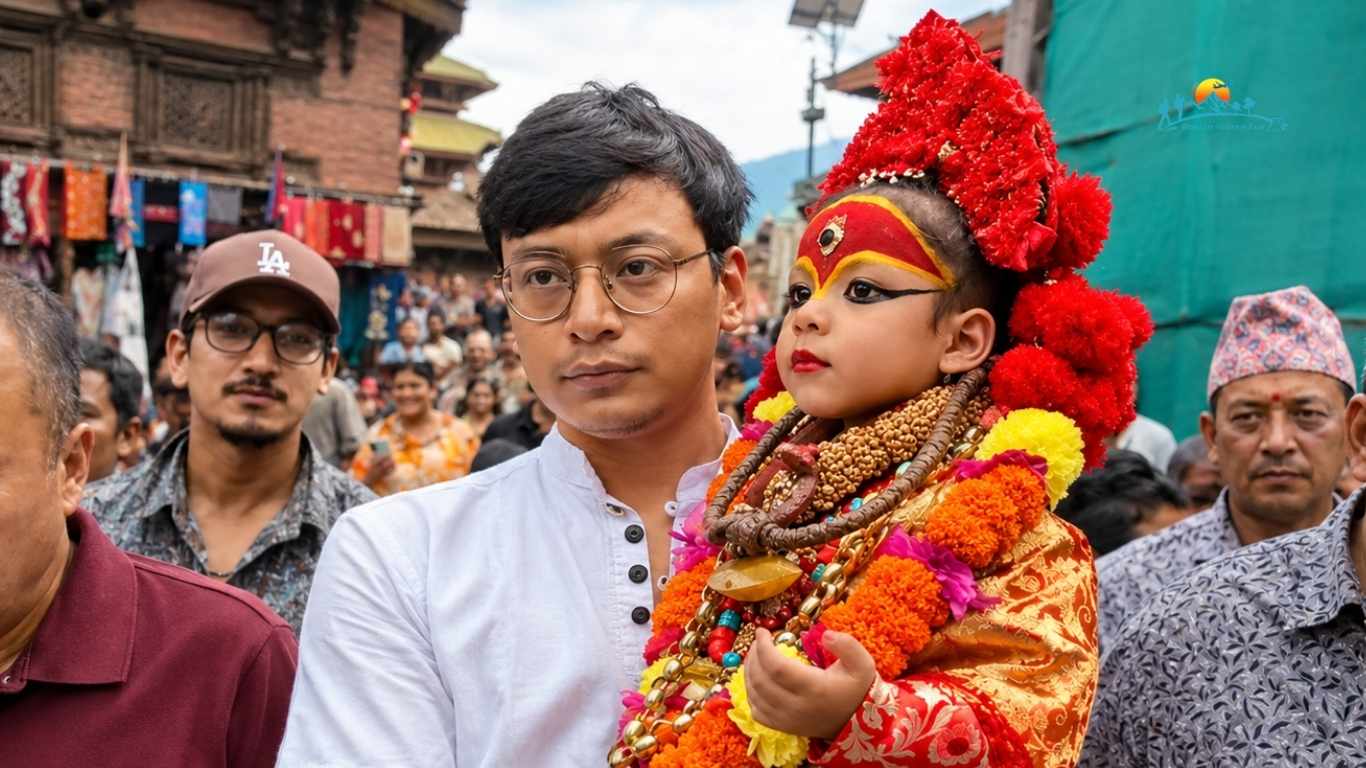
The traditional selection process is often described through the idea of the 32 lakshanas, or signs of perfection.
Different sources give different English translations and lists of these characteristics. Academic writing about the Kumari describes traits connected with the eyes, hair, teeth, voice, skin, body shape, limbs, and other physical features.
It is better to understand the 32 signs as part of a traditional religious idea than as a modern beauty checklist.
Some commonly described qualities include:
The exact wording differs between sources, and some old lists contain descriptions that sound very unfamiliar to modern readers. Rather than presenting one disputed list as the only correct version, it is more useful to explain that the signs represent an old religious standard of bodily perfection.
After choosing her, a Kumari begins a life that is nothing like that of a normal child. She resides in Kumari Ghar where she is offered ritual care and meets devotees at specific times and leaves the house for some religious events. The setting is religious and the needs of the young child are catered for.
Kumari Ghar (Kumari’s house) is an historic building in Kathmandu Durbar Square, where the royal Kumari resides. It has been constructed by King Jaya Prakash Malla in 1757 and is known for its intricate wood carvings and traditional architecture of the Newars.
She performs religious rituals, welcomes her devotees and prepares for festivals every day. Her daily requirements are provided for by caretakers and there is also an education system in place of modern education, provided by private tutors.
Yes. In the modern era, the Kumaris are educated whilst performing their religious functions. The tradition has also evolved so that they can safeguard their education, welfare and future once retired.
The Kumari does not allow her feet to touch the ground when she is travelling outside Kumari Ghar. She can be carried or put in a palanquin or chariot, as she is sacred.
The Kumari follows a daily routine that includes school, private activities, and religious rituals, so she is not present at the window throughout the day.
For visitors, there is only one opportunity to visit Kumari Ghar, and this visit is available in the morning.
Kumari Ghar Visiting Time: 9:30 AM – 12:00 PM
After this time visitors have the opportunity to see the Kumari through the window of Kumari Ghar at 4:30 PM. During this time, the Kumari will come to the window and give darshan to visitors.
The expressions and gestures of the Kumari are given meaning through traditional beliefs. Her actions have been observed by devotees for centuries and some actions have been taken as a sign.
In some Kumari text, crying, shaking, laughing out of the ordinary or other movements are linked to certain results. Such interpretations are within the realm of religious conviction and are not necessarily seen as predictions of what will happen.
This distinction matters because a facial expression has an ordinary explanation in a child just as it does in any other human being.
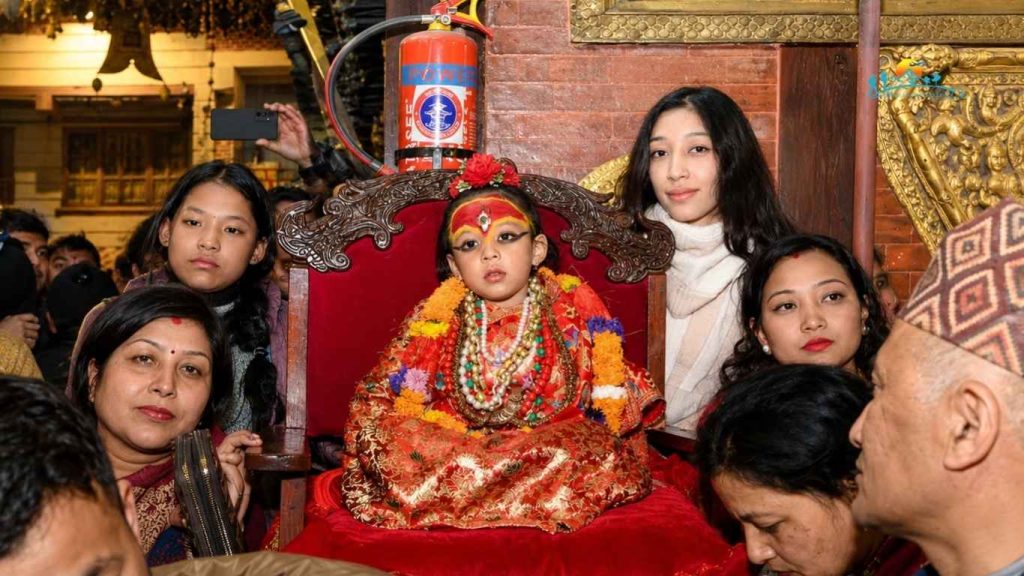
She normally wears red ceremonial clothing, her hair is arranged in a traditional style, and a third eye is painted on her forehead. The red clothing, topknot hairstyle, and third eye during its 2025 report on the new Royal Kumari.
The third eye, red clothes, jewellery etc. of the Kumari’s appearance are all significant elements of the presentation of the Kumari.
It is important to remember that the third eye is a symbol of a religious nature and not necessarily of an actual supernatural gift of sight. The red colour is also sacred and sacred femininity in south Asian culture and is strongly connected with divine power and sacred femininity in Nepal.
The Living Goddess Kumari is important because she represents a number of aspects of Kathmandu’s cultural life.
She connects:
| Part of Kathmandu life | Connection with the Kumari |
|---|---|
| Religion | Devotees seek blessings from a living representation of the goddess |
| Newar culture | The Royal Kumari is selected from the Newar Shakya community |
| Hindu tradition | The Kumari is associated with Taleju Bhawani |
| Buddhism | The selected girl comes from the Buddhist Shakya community |
| Festivals | She appears publicly during major festivals |
| History | Her role is linked with the Malla and Shah periods |
| Architecture | Her residence, Kumari Ghar, stands at Kathmandu Durbar Square |
| Modern society | Her role raises questions about education, childhood, and cultural continuity |
Aryatara Shakya is the current Royal Kumari of Itumbahal Kathmandu.
She was selected as the new Royal Kumari in September 2025 and entered the Kumari Ghar on September 30, 2025. At the time of her selection, she was two years and eight months old. She succeeded Trishna Shakya, who served as the Royal Kumari from 2017 to 2025.
The role of a Kumari is a temporary one and is normally terminated when she reaches puberty, especially on the first time of menstruation. She might also be at risk of serious injury or blood loss that can impact her traditional beliefs.
A retired Kumari resumes normal life, such as attending school, socializing, or working or interacting with family. This transition can be challenging after many years of ceremonial responsibilities.
Yes. Former Kumaris can marry and have normal lives after leaving the tradition. The belief that marrying a former Kumari brings bad luck or death is only a traditional belief, not a proven fact.
The best place to see the Living Goddess, Kumari is in Kathmandu Durbar Square, Basantapur. The historic building is the home of the Royal Kumari and one of the main cultural sites in the square.
The Kumari can only be seen at certain times of the day, and she is only allowed to be seen by visitors if she is a child and a religious figure. People should obey the staff instructions and adhere to the in-house guidelines as to Kumari Ghar.
The rules for photographing may differ, please don’t assume you can photograph the Kumari. Please read the latest instructions before taking photographs and come and go in a respectful manner.
The Royal Kumari of Kathmandu is the most famous, but the wider Kumari tradition extends beyond Basantapur.
The Nepal Tourism Board notes Kumaris in Patan, Bhaktapur, Bungmati, Thimi, and other Newar towns.
Historical legal material from Nepal has also recorded multiple Kumari traditions in the Kathmandu Valley, showing that the practice has never been limited to one child in one city.
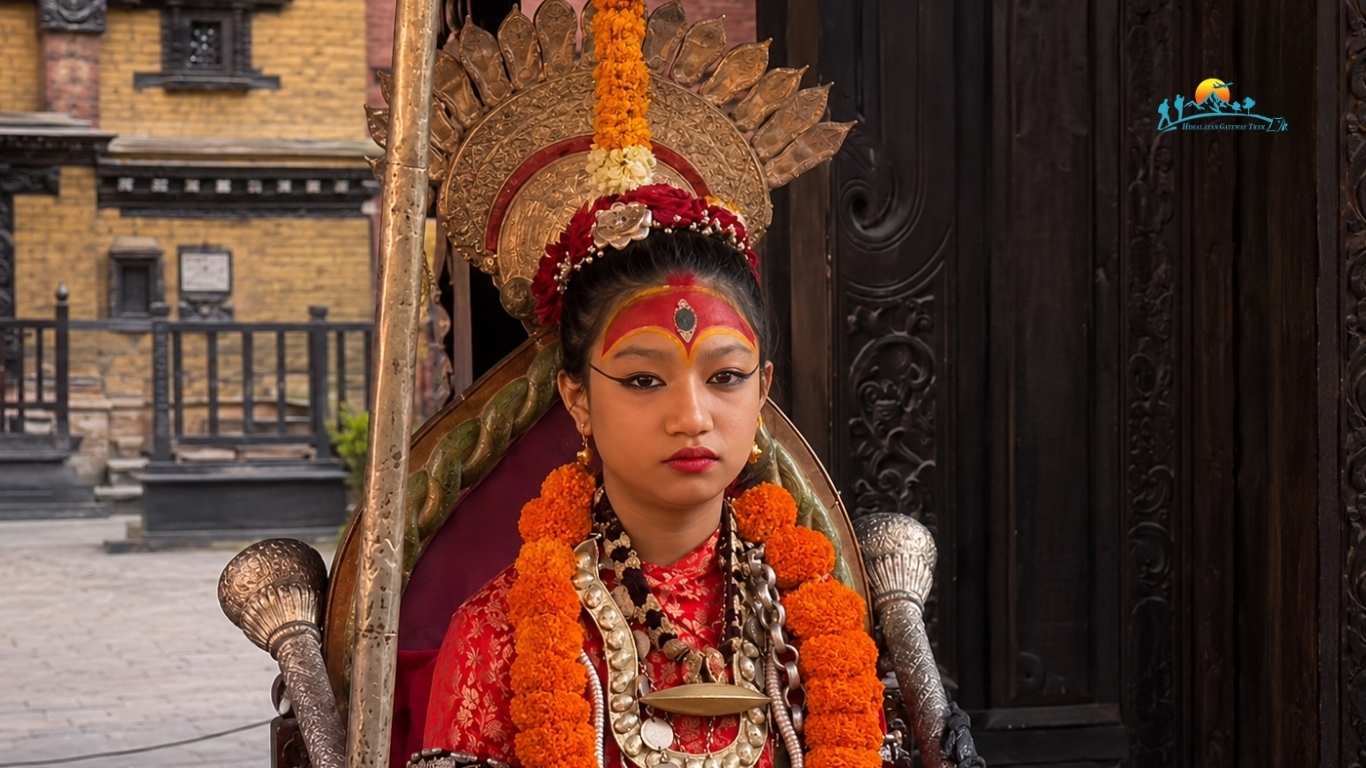
Patan, also known as Lalitpur, has its own Kumari tradition.
The Patan Kumari is important within the religious life of the city and should not be treated as a smaller version of the Kathmandu Royal Kumari. The local tradition has its own history and community setting.
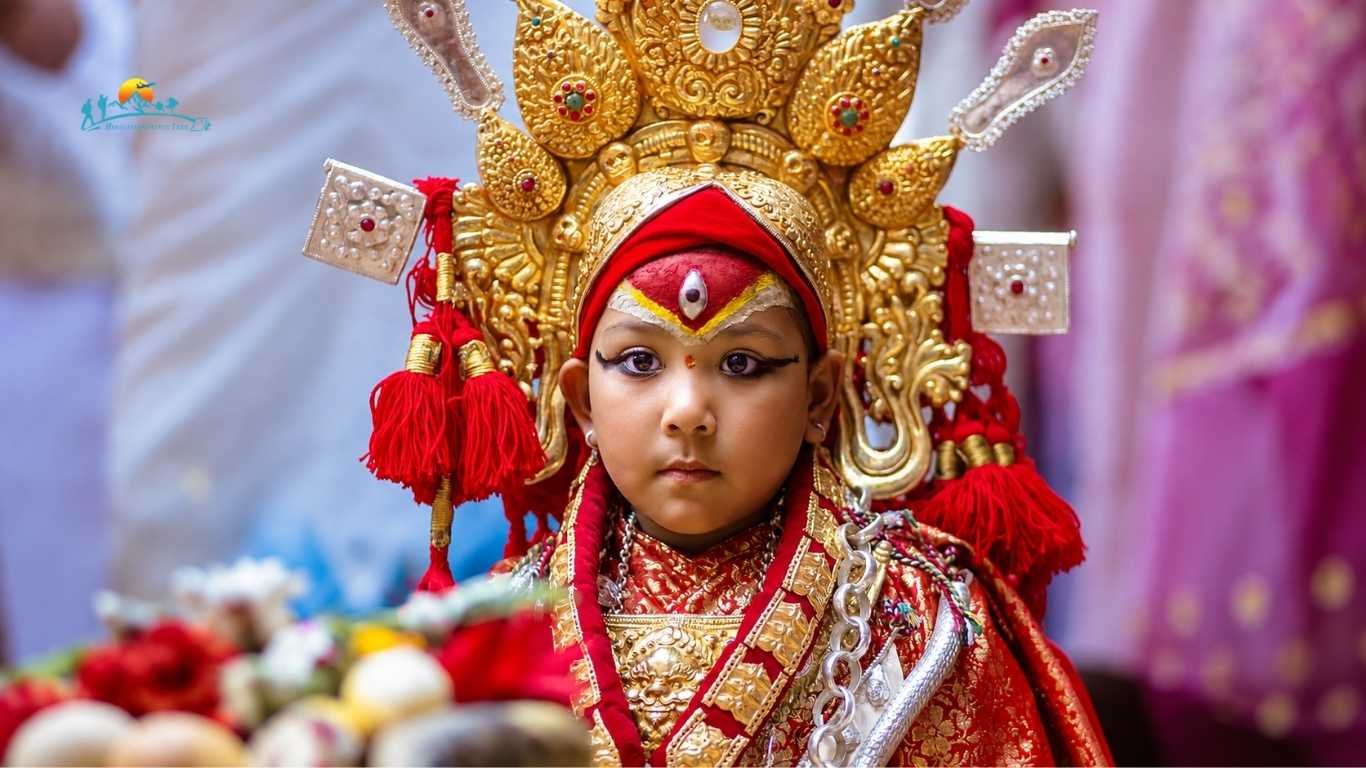
Bhaktapur also has a long-standing Kumari tradition.
Bhaktapur’s history, architecture, festivals, and Newar religious practices differ in some ways from those of Kathmandu. The local Kumari belongs to that wider cultural setting.
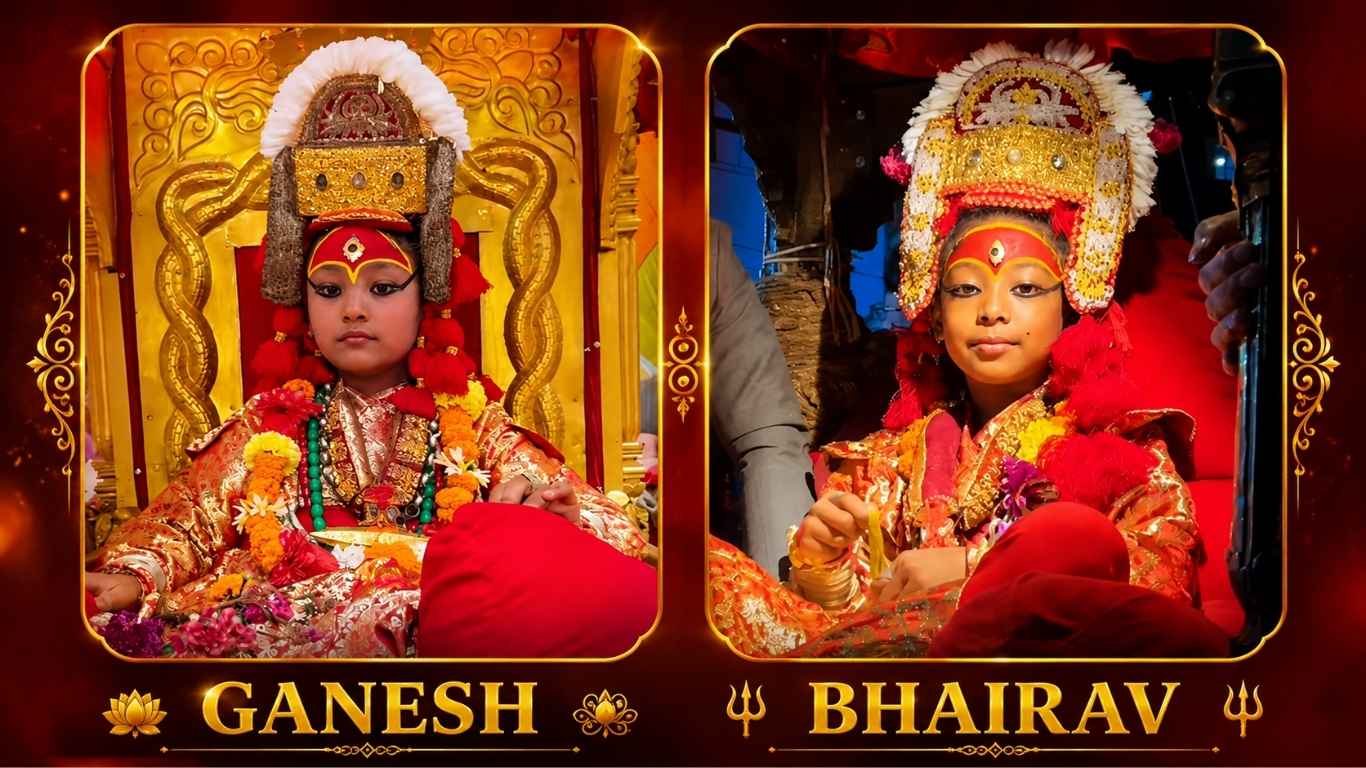
Alongside the Living Goddess Kumari, Kathmandu’s Indra Jatra tradition also features two living child deities who represent Ganesh and Bhairav. These children are taken through the streets in ceremonial chariots during the festival, alongside the Kumari’s chariot.
The three chariots have important religious roles, with the Kumari representing the goddess, Ganesh representing the Hindu elephant-headed deity, and Bhairav representing a powerful form associated with Shiva. Together, they form a central part of the Indra Jatra celebrations in Kathmandu.
These living deities are selected from young boys according to traditional religious practices and are honored during the festival. Their presence alongside the Kumari reflects the importance of Ganesh, Bhairav, and Kumari in Kathmandu’s religious and cultural traditions.
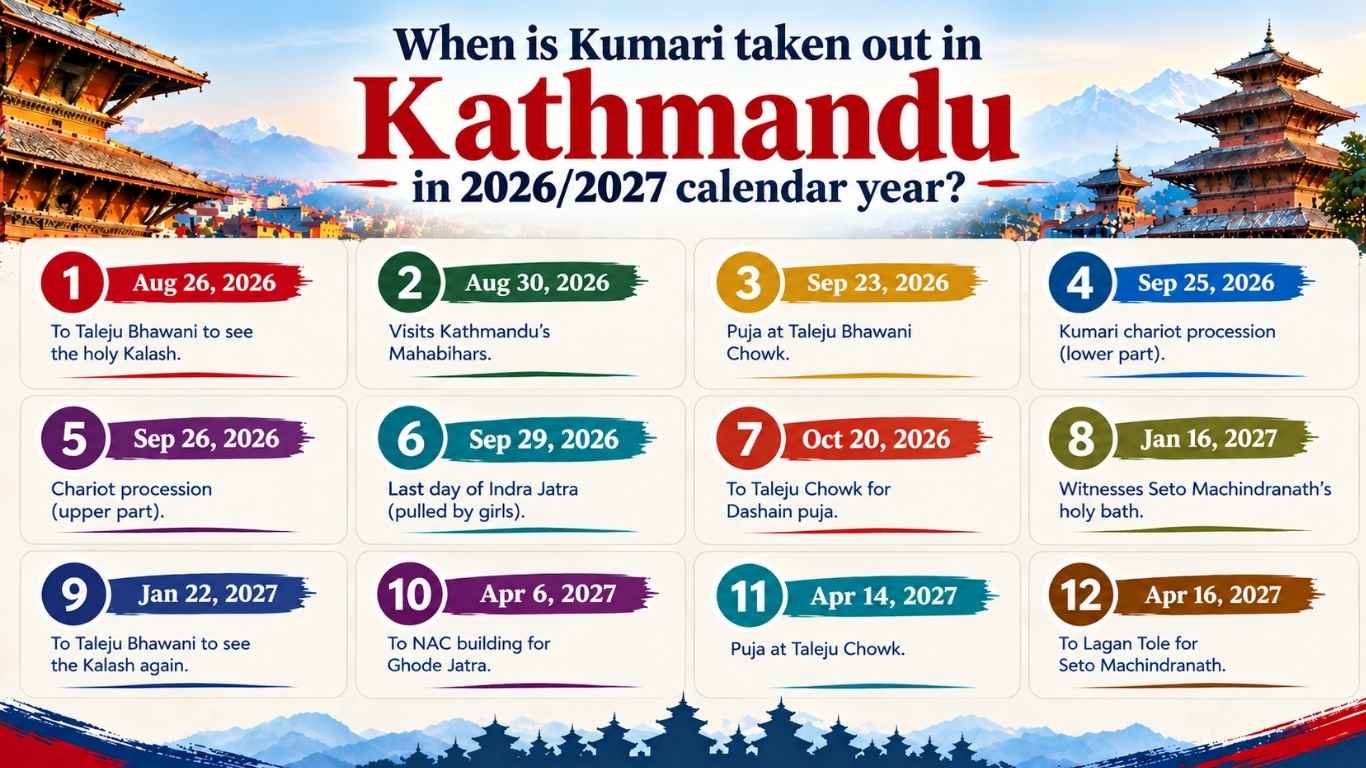
Kumari is taken out for 12 times in a calendar year they are as follows:
On this day, Kumari will be carried to the gates of Taleju Bhawani to witness the arrival of the sacred Kalash carrying holy water from Changu Narayan, brought on foot to Hanumandhoka.
The day after Sa Paru ( Gai Jatra ), Kumari is carried to different Mahabihars of Kathmandu, including Itumbaha, Bhagwanbaha, Chusyabaha, and Janabaha. It is an annual festival where Kumari visits different Baha and Bahi in Kathmandu to honor Bahidyo and see the unique traditions and deities of each place.
On this day, Kumari, along with Ganesh and Bhairav, is carried into Taleju Bhawani Chowk for a puja before Indra Jatra begins.
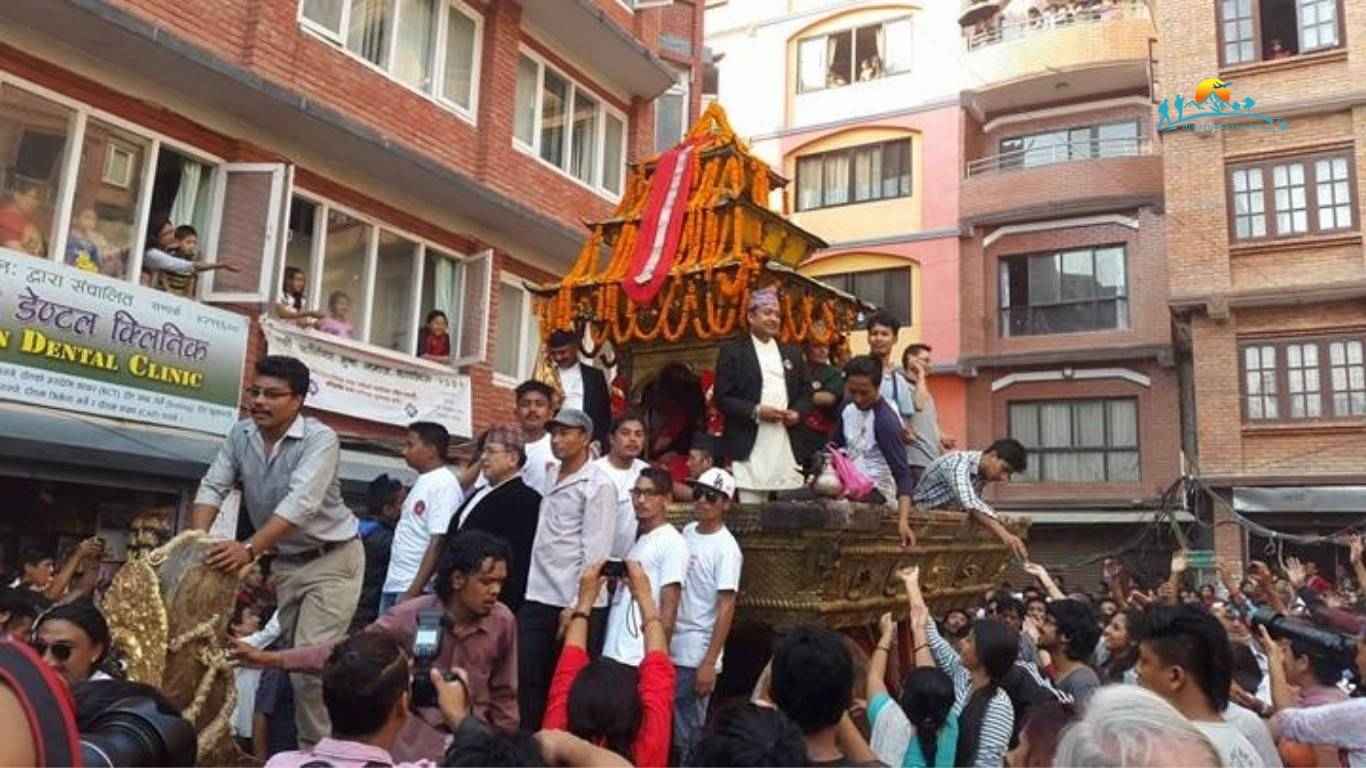
This day marks the beginning of the Kumari chariot procession during Indra Jatra. Kumari, along with Ganesh and Bhairav, is taken out in their chariots and carried through the lower part of Kathmandu. After completing the procession, the chariots return to Basantapur. This day is called Kwoneyaa, meaning Lower Tole.
The second day of the Kumari chariot procession. On this day, chariots of Kumari, Ganesh, and Bhairav are taken to the upper part of the Kathmandu Valley. Chariots pass through areas like Ason, Indra Chowk, and Hanumandhoka. Before returning to Basantapur, chariots stop at Aakash Bhairav temple in Indra Chowk and Seto Bhairav temple in Hanumandhoka to see the serving of blessed liquor directly from the mouth of these Bhairavs before returning to Basantapur.
This day is called Thaneya, meaning Upper Tole.
This is the last day of Indra Jatra this day is also called Nanichaya. On this day, the chariots are pulled from Basantapur and taken to the mid part of the Kathmandu Valley, which includes Kilagal. They then pass through Indra Chowk and Hanuman Dhoka before returning to Basantapur. On this day, the chariots are traditionally pulled by girls.
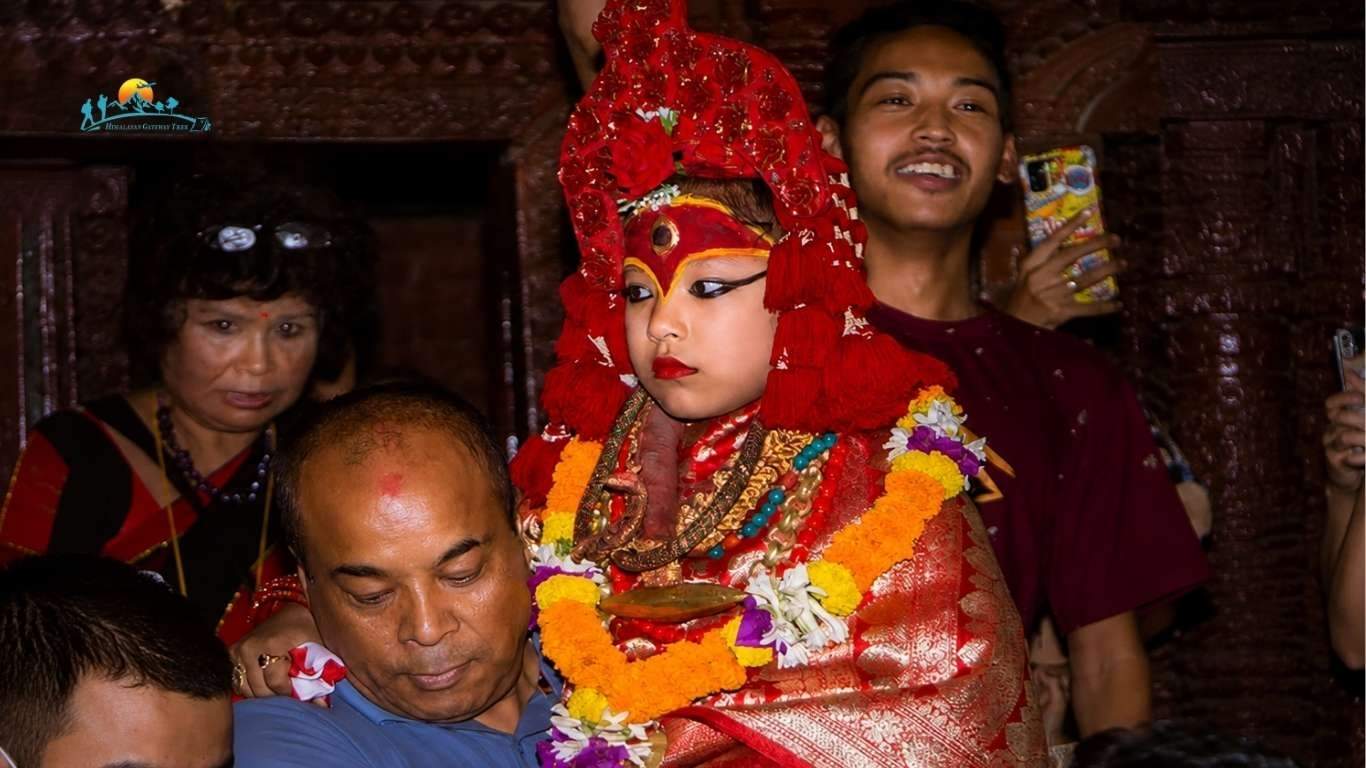
This is Mahanavami, the ninth day of the Dashain festival in Nepal. On this day, Kumari, Ganesh, and Bhairav are taken to Taleju Chowk once again for puja.
On Poush Shukla Ashtami, Kumari is taken to Janabahal to witness the holy bathing ceremony of Seto Machindranath.
On this day, Kumari will be carried to the gates of Taleju Bhawani to witness the arrival of the sacred Kalash carrying holy water from Changu Narayan again.
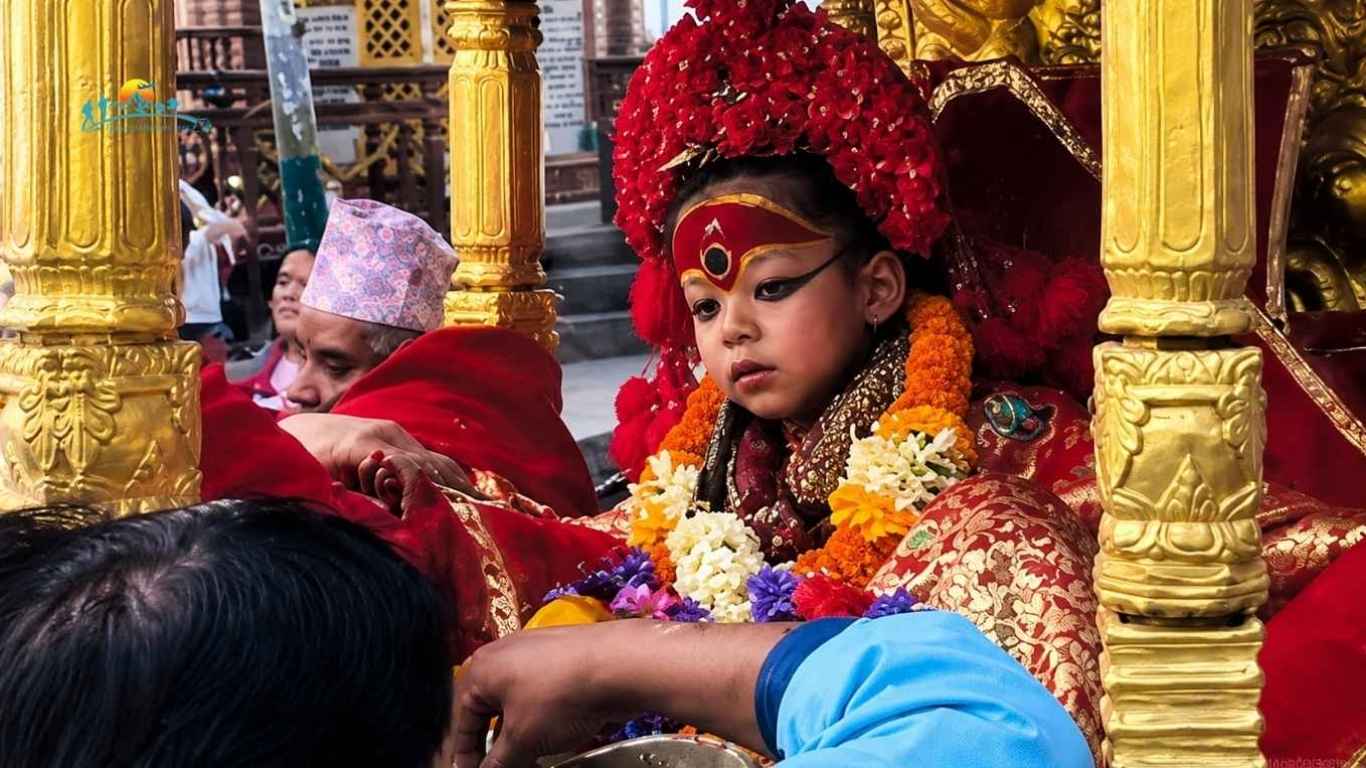
This is the day of Ghode Jatra. On this day, Kumari is taken to the top floor of the NAC building, where a special room is reserved for her. From there, she can watch the Ghode Jatra celebrations taking place at Tundikhel.
On this day, Kumari is taken to Taleju Chowk, where a special puja is performed as part of the Chaitra Dashain celebrations.
On this day, during the Seto Machindranath Jatra, Kumari is taken to Lagan Tole, where the temple of Seto Machindranath’s mother is located. From there, she witnesses Seto Machindranath make a ceremonial round around his mother. This is the final appearance of Kumari for this year.
| Common claim | What visitors should understand |
| There is only one Kumari in Nepal | Several Kumari traditions exist, especially in the Kathmandu Valley. |
| The Kumari remains a goddess forever | The role is temporary and normally ends when the girl reaches puberty. |
| The Kumari can predict the future with certainty | Traditional beliefs attach meanings to some gestures, but these are religious interpretations. |
| The Kumari is only a Hindu figure | She is closely connected with Hindu goddess traditions and is also revered by Buddhists. |
| Former Kumaris cannot marry | This is a popular belief, not a rule that prevents marriage. |
| The Kumari never receives education | Modern Kumaris can receive education, including private lessons. |
| Kumari Ghar is simply a tourist attraction | It is a religious residence as well as a historic building. |
| Every detail of selection is exactly the same everywhere | Selection practices differ between Kumari traditions and sources. |
Despite the transition from monarchy to republic in Nepal, the Living Goddess Kumari continues to play a significant role in the nation’s religious and cultural life.
Her tradition is related to Newar culture, Buddhist Shakya families, Hindu worship of Taleju and the important festive occasions like Indra Jatra.
The Kumari is a sacred figure who has been handed down through generations for devotees. To visitors, she is an opportunity to see more than historic buildings, but a living tradition.
Kumari Ghar is thus not just a tourist attraction. It is still an important live cultural heritage of Kathmandu.
The Living Goddess Kumari is not just a child in a fortressed old palace. The tradition links Newar culture, Hindu and Buddhist religion, the former history of Kathmandu and the major festivals like Indra Jatra in Kathmandu.
A visit to the Kumari Ghar provides an insight into this living tradition, whereas festivals highlight the close association of the Kumari with religious life in Kathmandu. The tradition is still evolving in today’s education and children’s rights conversation, too.
Today, Aryatara Shakya is the Royal Kumari of Kathmandu. Her choice in 2025 demonstrates that the Kumari tradition is not just a historical phenomenon in Nepal but continues to be a vibrant facet of its culture.
The Kumari is a prepubescent girl worshiped in Nepal as the living incarnation of the Hindu goddess Taleju. Revered by both Hindus and Buddhists, she resides in a sacred temple, protecting the nation until she reaches puberty.
Yes, former Kumaris are absolutely allowed to marry. Despite an old, baseless superstition claiming that marrying an ex-goddess brings early death to the husband, modern retired Kumaris routinely marry, raise children, and enjoy completely normal, happy family lives.
In 2026, the Royal Kumari of Kathmandu is Aryatara Shakya. She was officially crowned as the living goddess in September 2025 at just two years old, succeeding the former Royal Kumari, Trishna Shakya, who retired upon reaching maturity.
Traditionally, some devotees believe that if the Kumari smiles or laughs during a blessing, it is a bad omen linked to illness or death. However, this is a religious belief and folklore, not a proven fact or certain prediction.
Buddhist priests and astrologers select the Kumari from the Shakya caste of the Newar community. Candidates undergo rigorous secret rituals, must show absolute fearlessness, and pass thirty-two strict physical perfection tests before being officially crowned.
A Kumari must possess thirty-two perfections of a goddess, known as battis lakshanas. These include unblemished skin, a body like a banyan tree, eyelashes like a cow, a chest like a lion, and thighs like a deer.
A Kumari steps down when she experiences her first menstruation, loses blood from a severe injury, or suffers a serious illness. This loss of blood signifies the goddess Taleju has left her earthly, mortal body.
The Royal Kumari lives isolated in the Kumari Ghar in Kathmandu. Her feet must never touch the ground outside. She blesses devotees daily, studies with private tutors, and only leaves her residence during major religious festivals.
Tourists can view the Royal Kumari when she occasionally appears at the carved wooden window of the Kumari Ghar in Kathmandu. However, taking photographs is strictly prohibited, and visitors must behave respectfully during her brief appearances.
After retiring, the girl transitions back to normal society. She returns to her family, attends a regular public school, receives a state pension, and eventually pursues higher education, a career, and marriage like any other citizen.