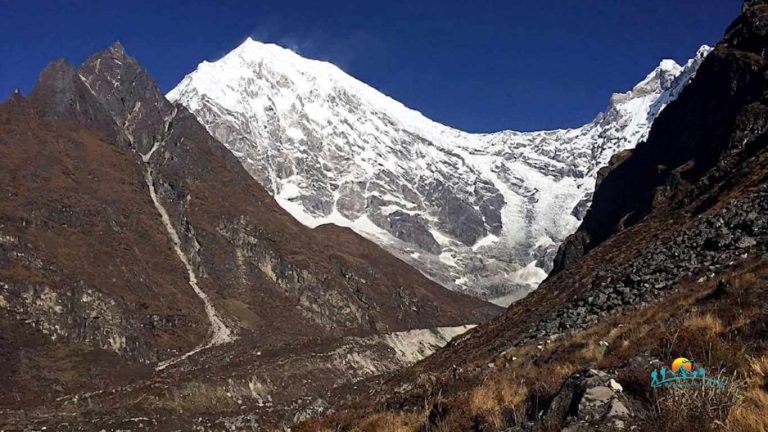
Yes, there are animals found in Mount Everest, not only in the surrounding valleys but also at extreme altitudes where oxygen levels are low, and temperatures remain below freezing for most of the year. While no large animal lives on the summit itself, Mount Everest supports a wide range of mammals, birds, and small creatures across different altitude zones. These species have developed physical and behavioural traits that allow them to survive in one of the harshest environments on Earth.
This guide explains which animals are found in the Everest region, where they live, how they survive, and why their presence matters to the Himalayan environment.
Table of Contents
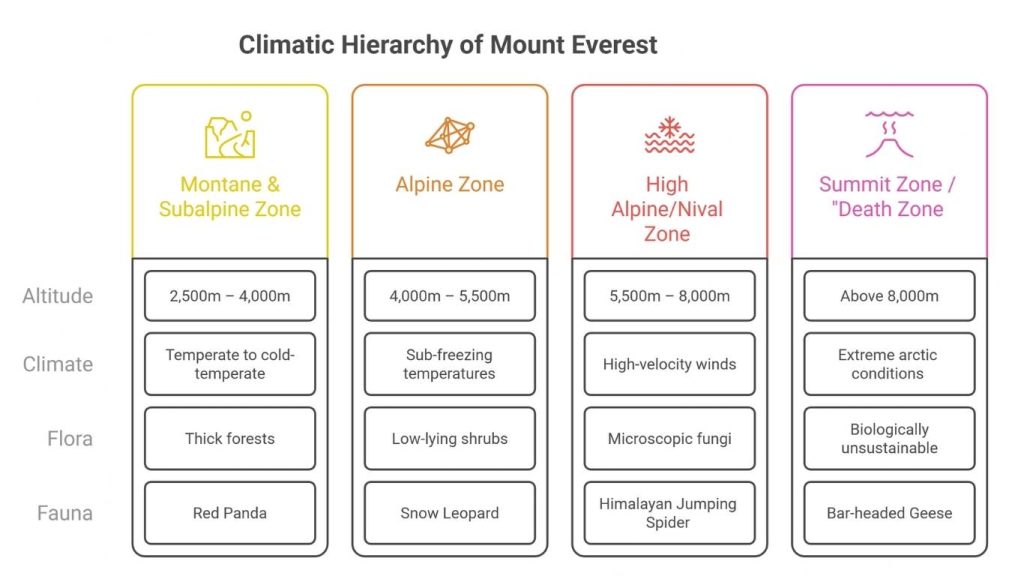
The Climatic Hierarchy of Mount Everest
The mountain is divided into distinct altitudinal belts, each defined by its temperature gradient, oxygen density, and biological capacity.
1. The Montane & Subalpine Zone (2,500m – 4,000m)
This is the “green lung” of the Everest region. While the air begins to thin, the environment is still hospitable enough to support dense life.
Climate: Temperate to cold-temperate; receives significant monsoon rainfall.
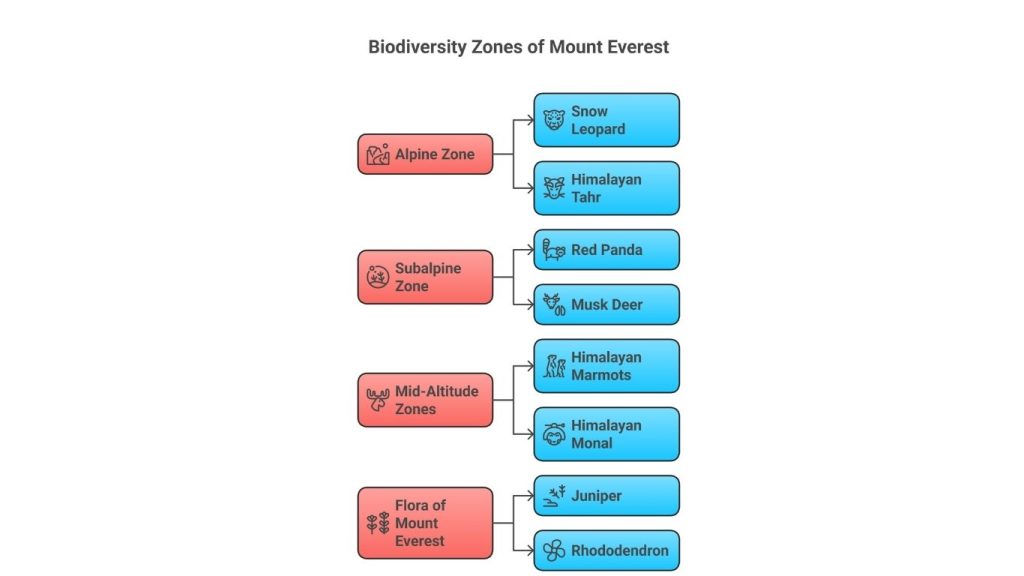
Flora: Thick forests of birch, blue pine, and rhododendron.
Fauna: This is the primary habitat for the Red Panda, Musk Deer, and various langur monkeys.
2. The Alpine Zone (4,000m – 5,500m)
Above the tree line, the landscape shifts to a rugged, tundra-like environment. The weather becomes unpredictable, with rapid shifts between intense solar radiation and freezing winds.
Climate: Sub-freezing temperatures for much of the year; high UV exposure.
Flora: Low-lying shrubs, mosses, and hardy alpine wildflowers.
Fauna: Home to the elusive Snow Leopard and the Himalayan Tahr. These animals have evolved specialized hemoglobin to thrive in lower oxygen levels.
3. The High Alpine/Nival Zone (5,500m – 8,000m)
This is the realm of permanent snow and ice. Vegetation is almost non-existent, restricted to microscopic fungi or specialized “cushion plants.”
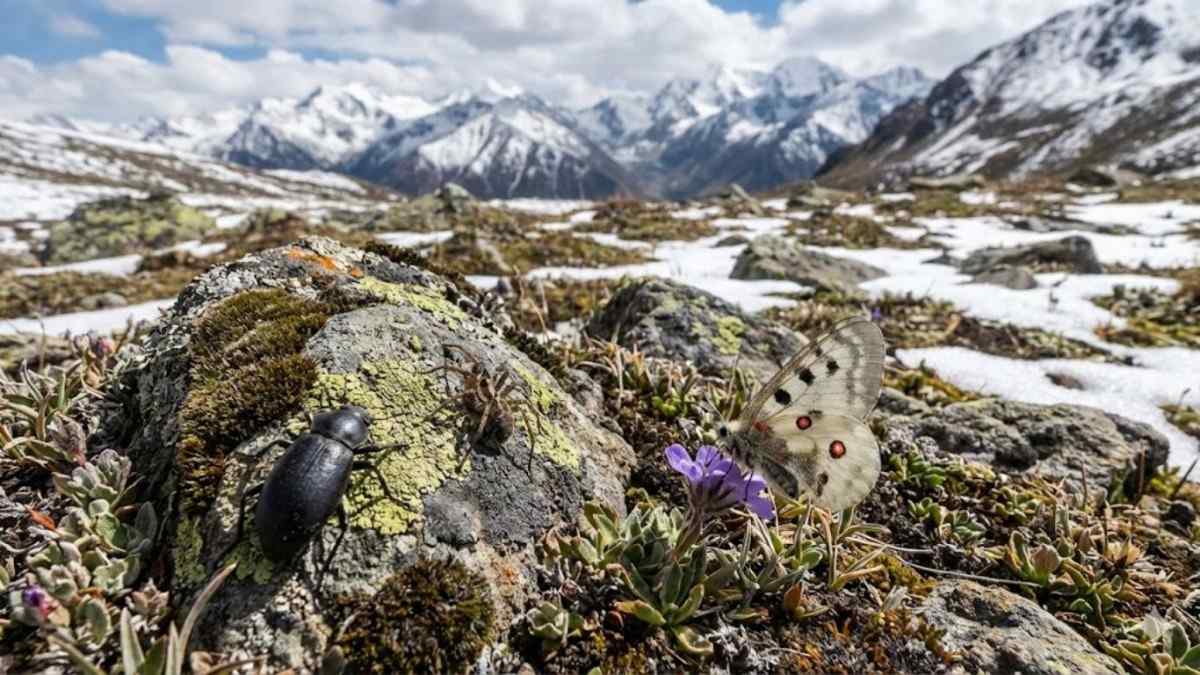
Fauna: Surprisingly, the Himalayan Jumping Spider has been found as high as 6,700m, feeding on insects blown up by the wind.
4. The Summit Zone / “Death Zone” (Above 8,000m)
In this final tier, the partial pressure of oxygen is only about one-third of that at sea level.
Climate: Extreme arctic conditions. Temperatures can plummet to -60°C (-76°F).
Life: This zone is biologically unsustainable for long-term survival. However, Bar-headed Geese are famous for migrating directly over the summit, utilizing highly efficient lungs that allow them to fly where helicopters cannot.
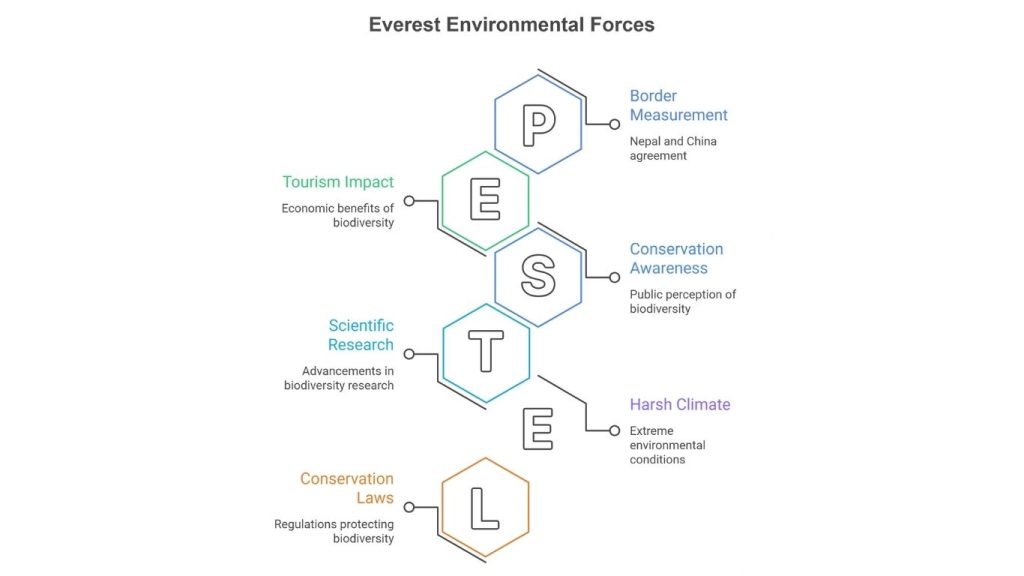
Environmental Forces & Biological Adaptation
The biodiversity of Everest is a masterclass in evolutionary resilience. Because the environment is so unforgiving, the species here have developed specialized traits:
Insulation: Thick, multi-layered fur and increased body fat are standard for mammals like the Snow Leopard.
Respiratory Efficiency: High-altitude species possess larger lung capacities and blood with a higher affinity for oxygen.
Migration Patterns: Many species are “vertically migratory,” moving to lower, warmer zones during the brutal winter months and ascending as the ice melts in the spring.
Geographic Note: Recent surveys have officially updated Everest’s height to 8,848.86 meters, a joint measurement by Nepal and China that accounts for the snow cap and tectonic shifts following the 2015 earthquake.
Climatic Hierarchy & Atmospheric Conditions
Tundra Zone: Tree line ends; Base Camp is located here. The risk of Acute Mountain Sickness (AMS) increases significantly.
Altitude Range
Effective Oxygen (% of Sea Level)
Avg. Temperature Range (Spring/Autumn)
Biological & Physiological Impact
Montane / Subalpine
2,500m – 4,000m
75% – 60%
5 Degree Celsius to 15 Degree Celsius (Day) / 0 Degree Celsius to −10 Degree Celsius (Night)
Acclimatization Zone: Vegetation is lush; humans begin to feel the first signs of altitude (shortness of breath).
Alpine
4,000m – 5,500m
60% – 50%
5 Degree Celsius to −5 Degree Celsius (Day) / −10 Degree Celsius to −20 Degree Celsius (Night)
Tundra Zone: Tree line ends; Base Camp is located here. Risk of Acute Mountain Sickness (AMS) increases significantly.
High Alpine (Nival)
5,500m – 8,000m
50% – 35%
−15 Degree Celsius to −25 Degree Celsius (Day) / −25 Degree Celsius to −35 Degree Celsius (Night)
Glacial Zone: Permanent snow/ice. Minimal life. Digestion slows and the body struggles to repair tissue.
Summit / Death Zone
Above 8,000m
Below 33%
Glacial Zone: Permanent snow/ice. Minimal life. Digestion slows, and the body struggles to repair tissue.
Extreme Zone: The body consumes its own muscle for energy; supplementary oxygen is required for most humans to survive.
Key Insights & Latest Geographic Updates
The Effective Oxygen Reality: While the air at the summit still technically contains 21% oxygen, the atmospheric pressure is so low that you only take in about one-third of the oxygen molecules per breath compared to sea level.
The Jet Stream Factor: During the winter, the Northern Hemisphere Jet Stream sits directly on the summit, creating hurricane-force winds exceeding 280 km/h (175 mph). This is why the climbing window is strictly limited to May and October when the Jet Stream shifts.
New Height Confirmation: As of the latest joint survey by Nepal and China, the official height is recognized as 8,848.86 meters (29,031.7 feet). This update accounts for the 2015 Gorkha earthquake, which caused subtle shifts in the Himalayan crust.
Microbial Life: Recent studies have discovered that even in the “Death Zone,” certain bacteria and fungi (carried by wind or humans) can survive in a dormant state, showing that Everest’s environment is not entirely sterile.
Where Are Animals Found in Mount Everest: Altitude Zones Explained
Animals found on Everest are not evenly distributed. Their presence depends on altitude, vegetation, temperature, and oxygen availability.
Lower Himalayan Forest Zone (Below 3,000 meters)
Dense forests with bamboo, oak, and rhododendron
The highest biodiversity is in the Everest region
Year-round food availability
Subalpine Zone (3,000 to 4,000 meters)
Alpine meadows and shrubs
Seasonal migration zone for many animals
Cold winters and short summers
Alpine and High-Altitude Zone (Above 4,000 meters)
Sparse vegetation and rocky terrain
Low oxygen levels
Only highly adapted animals survive here
The Altitude Map: Where Animals Found on Mount Everest Live
The following table provides a clear breakdown of wildlife distribution by elevation. This vertical mapping helps trekkers know exactly what to look for at different stages of their journey.
Elevation Zone
Altitude Range
Primary Wildlife
Typical Habitat
Lower Forest
2,500m to 3,500m
Red Panda, Musk Deer, Langur Monkey
Bamboo and Rhododendron forests
Subalpine Zone
3,500m to 4,500m
Himalayan Tahr, Blood Pheasant, Monal
Scrubland and rocky slopes
High Alpine
4,500m to 5,500m
Snow Leopard, Blue Sheep, Pika
Barren rock and snowfields
Nival Zone
Above 5,500m
Himalayan Jumping Spider, Bar-headed Goose
Eternal ice and thin air
Iconic Mammals of the Everest Region
Mammals form the most visible group of animals found on Everest. Most are concentrated below the summit but can be found at surprisingly high elevations.
1. The Snow Leopard (Panthera uncia)
Known locally as the “Ghost of the Mountains,” the Snow Leopard is the apex predator of the region around Mount Everest. They reside primarily between 3,000 and 5,500 meters. Their thick, smoky-grey fur provides perfect camouflage against the granite cliffs. Their exceptionally long tails help them maintain balance on steep ledges and serve as a warm wrap during sleep.
2. Himalayan Tahr
Trekkers frequently see these large, wild goats. They have thick, reddish-brown coats and short, backward-curving horns. They are remarkably sure-footed, often seen grazing on near-vertical cliffs where predators cannot reach them. They reside between 2,500 to 5,000 meters above sea level and are the primary herbivores.
3. Red Panda
The Red Panda is found in the lower, humid forests of the Khumbu region. These animals prefer the dense bamboo undergrowth near Phakding and Manjo. They reside between 2,200 to 4,000 meters. They are primarily nocturnal, use their bushy tails for warmth and balance while navigating the canopy, and inhabit forested areas.
4. Musk Deer
Musk deer are solitary and mostly nocturnal. They survive cold conditions with dense fur and low movement during the winter months. They reside between 2,500 to 4,500 meters. Poaching has made them increasingly rare. Unlike other deer, they lack antlers and instead possess long, vampire-like fangs used by males during territorial disputes.
5. Himalayan Goral
This goat-antelope species lives on rocky slopes and forest edges. Its agility allows it to escape predators in steep terrain. They reside between 1,800 to 4,000 meters.
6. Himalayan Black Bear
The Himalayan Black Bear is a medium-sized bear found in the forested and mountainous regions of the Himalayas, including parts of India, Nepal, Bhutan, and Pakistan. It is easily recognized by its black fur and a distinctive white or cream-colored V-shaped mark on its chest. This bear is omnivorous, feeding on fruits, nuts, insects, small animals, and sometimes crops.
7. Wild Yak and Domesticated Yak
Wild yaks are powerful animals adapted to thin air through large lungs and high red blood cell counts. Domesticated yaks are essential to local communities, providing transport, food, and fuel. They reside between 3,000 to 5,500 meters. It is widely seen in the Everest Base Camp region.
Birds Found in Everest
1. Bar-Headed Goose
The Bar-headed Goose is a biological marvel. These birds migrate across the Himalayas, reaching altitudes above 8,000 meters. They possess specialized hemoglobin that binds oxygen more efficiently than other birds, allowing them to flap their wings in the air that would leave a human unconscious.
2. Himalayan Monal (Danphe)
As Nepal’s national bird, the Monal is famous for its iridescent, multicolored plumage. They are often spotted digging for roots and insects in the meadows around Namche Bazaar and Everest View Hotel. It resides between 2,400 to 4,500 meters.
3. Snow Partridge and Tibetan Snowcock
Snow Partridge and Tibetan Snowcock are ground-dwelling birds that stay close to alpine terrain to conserve energy in harsh conditions. Their thick feathers help them retain body heat in freezing temperatures, and they survive by feeding on seeds and tough alpine plants found on rocky slopes. It ranges from 3,500 to 5,000 meters.
4. Golden Eagle
Golden eagles are powerful predators that hunt marmots and other small mammals. They adjust altitude based on prey availability and weather conditions. It resides in the range of 2,000 to 5,000 meters, and its habitat is Open mountains and valleys.
5. Blood Pheasant
The Blood Pheasant is a colorful bird found in the Himalayan mountain range. It lives in high-altitude forests and alpine areas of India, Nepal, Bhutan, and China. The bird feeds on seeds, berries, insects, and plant roots.
Small Mammals and Insects Found in Everest
Smaller animals are essential to the survival of the Everest food chain.
1. Himalayan Pika
Himalayan pikas are found at altitudes up to 5,000 meters. They survive harsh winters by storing grass during the summer and are highly sensitive to temperature changes, which makes them vulnerable to climate fluctuations.
2. Himalayan Marmot
Himalayan marmots live in underground burrows and hibernate for long periods during the winter. They rely on stored body fat to endure the extreme cold of high-altitude environments.
3. High-Altitude Insects and Arthropods
High-altitude insects and arthropods are found above 5,000 meters. They can survive freezing temperatures and have short life cycles that are timed to the brief summer season.
The World’s Highest Inhabitant: The Jumping Spider
The Euophrys omnisuperstes, or the Himalayan Jumping Spider, holds the title for the highest permanent resident on Earth. These tiny spiders live in rock crevices at 6,700 meters. They do not build webs to catch prey. Instead, they hunt small insects and springtails that are carried up the mountain by high-altitude winds.
How Animals Found in Mount Everest Survive Extreme Conditions
Physical Adaptations
Thick fur and feathers
High red blood cell counts
Compact body shapes to reduce heat loss
Behavioral Adaptations
Seasonal migration
Hibernation and food storage
Reduced activity during extreme cold
Seasonal Survival
Animals adjust altitude based on food availability, moving to lower elevations during winter and returning to higher elevations during warmer months.
Spotter’s Guide: Where to See Wildlife on the Everest Trail
If you are planning a trek in Everest, use these specific locations to increase your chances of seeing the animals found in Mount Everest:
Phakding to Namche Bazaar: Look for Red Pandas and Langur Monkeys in the river valleys.
Around Namche Bazaar: Watch the cliffs for Himalayan Tahr and the meadows for the Himalayan Monal.
Tengboche Monastery: This is a prime area for spotting Musk Deer in the early morning or late afternoon.
Gokyo Lakes Valley: A known corridor for Snow Leopards. Look for their distinct tracks in the fresh snow.
You can use drones with permission to get a good view of Animals.
Facts About Animals Found in Mount Everest
Animals found on Mount Everest exhibit remarkable abilities that allow them to survive in extreme conditions. Birds have been recorded flying higher than Everest Base Camp, while certain insects have been found at elevations once thought uninhabitable. Snow leopards can leap more than 15 meters in a single bound, showcasing their strength and agility in high-altitude environments.
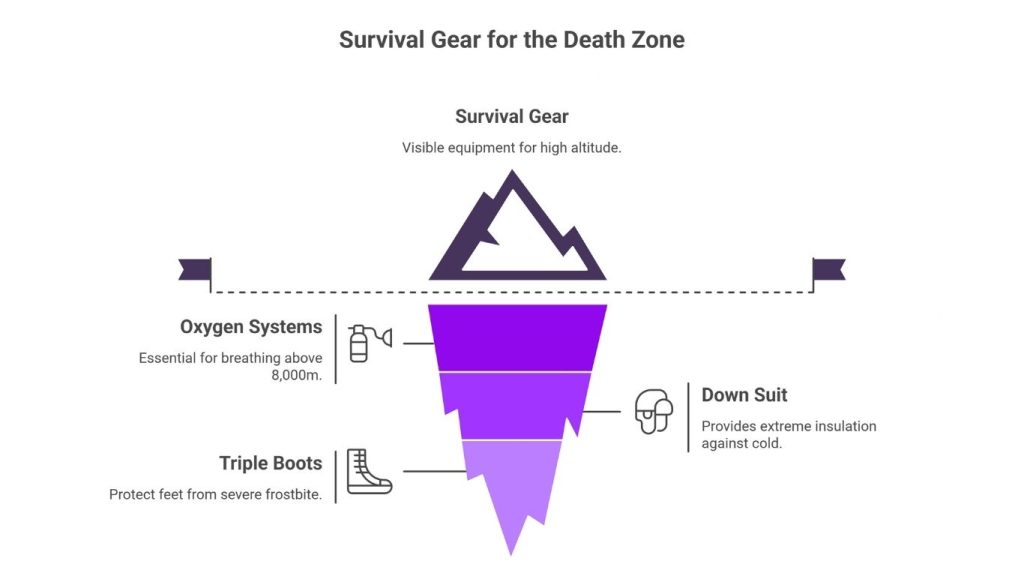
Survival Gear for the Death Zone (Above 8,000m)
At this altitude, the environment is actively trying to shut down human biology. Every piece of gear is a life-support system.
1. Supplemental Oxygen Systems
Because oxygen levels are below 33% of sea level, most climbers use a “closed-circuit” or “diluter-demand” system.
The Cylinders: Lightweight carbon-fibre bottles filled with compressed oxygen.
The Regulator: Controls the flow rate (usually measured in litres per minute, or LPM).
The Mask: A silicone-based mask (like the Topout or Summit Oxygen systems) designed to prevent valves from freezing shut due to condensation from the climber’s breath.
2. The 8000-Meter Down Suit
Standard winter clothing is insufficient. Climbers wear a massive, one-piece Down Suit.
Insulation: Stuffed with high-loft goose down (usually 800+ fill power) to trap body heat.
Outer Shell: Made of Gore-Tex or similar windproof/waterproof membrane to block the Jet Stream’s piercing winds.
Oxygen Pocket: Specially designed internal pockets to keep oxygen regulators warm, preventing them from freezing.
3. Footwear: Triple Boots
Standard hiking boots would lead to immediate frostbite. “Triple boots” consist of:
Inner Liner: A heat-moldable foam bootie for comfort.
Middle Boot: An insulated, stiff shell for support.
Integrated Gaiter: A knee-high, waterproof outer layer with Kevlar reinforcement to protect against crampon snags.
Geological History: How Everest Formed
Everest’s geography is a result of a continental collision that is still happening today.
The Tethys Sea (The Origin)
Surprisingly, the limestone at the very summit of Everest (the Qomolangma Formation) was once the bottom of a tropical ocean called the Tethys Sea. This is why climbers often find marine fossils (crinoids and shells) at nearly 29,000 feet.
The Indian-Eurasian Collision
The Event: About 40–50 million years ago, the Indian tectonic plate crashed into the Eurasian plate.
The Process: Because both plates were of similar density, neither would sink (subduct). Instead, the Earth’s crust buckled and folded upward.
Active Growth: This collision continues today. Everest is still technically growing at a rate of approximately 4 mm to 10 mm per year, though wind and glacial erosion constantly work to wear it back down.
Tectonic Shifts (2015 Earthquake)
The 7.8 magnitude earthquake in 2015 actually shifted the mountain. Data from the latest survey suggests the mountain moved about 3 centimetres to the southwest, though its height increased slightly to the current 8,848.86m.
FAQs
What is the most dangerous animal on Mount Everest?
Mount Everest hosts a variety of animals across different altitude zones, including snow leopards, Himalayan tahr, red pandas, yaks, Himalayan marmots, and high-altitude birds and insects. While no large animals live on the summit, these species thrive in forests, alpine meadows, and rocky slopes.
Are there snakes on Everest?
No, snakes are not found on Mount Everest. Extreme cold, low oxygen, and a lack of suitable habitats prevent reptiles from surviving at high altitudes.
What is the biggest killer on Everest?
The biggest dangers on Everest are environmental rather than animal-related. Avalanches, altitude sickness, extreme cold, and falls are the primary threats to humans and wildlife in the region.
Has any animal summited Everest?
No animal has been documented reaching the summit of Mount Everest. Most animals live in lower and mid-altitude zones, where they can find food and survive harsh conditions.
What is the creature on Mount Everest?
Mount Everest is home to a variety of creatures adapted to extreme high-altitude conditions. Key animals include snow leopards, Himalayan tahr, red pandas, yaks, Himalayan marmots, and several high-altitude birds and insects. While no large animals live on the summit itself, these species survive in forests, alpine meadows, and rocky slopes across different altitude zones.
Can humans live on Mount Everest?
Humans cannot live permanently on Mount Everest due to extreme cold, low oxygen levels, and harsh weather conditions. While climbers and Sherpa guides can survive temporarily at base camps or on short expeditions with specialized gear and supplemental oxygen, long-term habitation above 5,000 meters is impossible.
What animal lives at the highest altitude on Everest?
Some of the highest-living animals on Everest include the Himalayan pika, Himalayan marmots, and certain high-altitude insects. These species can survive extreme cold and low oxygen levels up to around 5,000 meters, although no animals inhabit the summit itself.
Are snow leopards found on Everest?
Yes, snow leopards inhabit the Everest region, primarily between 3,000 and 5,500 meters. They are elusive apex predators adapted to cold, rocky terrain and play a crucial role in maintaining the balance of the high-altitude ecosystem.









 Himalayan Gateway Trek - On