The Everest Base Camp Trek is one of the most iconic and sought-after adventures in the world, taking trekkers deep into the heart of the Khumbu region of Nepal. Over 14 days, this trek combines breathtaking Himalayan scenery, cultural immersion, and the unforgettable experience of standing at the foot of the world’s highest mountain, Mount Everest (8,848m).
The journey follows the footsteps of legendary mountaineers, beginning with a thrilling flight to Lukla and winding through vibrant Sherpa villages, ancient monasteries, lush forests, and glacial landscapes. Along the way, trekkers enjoy the warmth of Sherpa hospitality, learn about Buddhist traditions, and witness panoramic views of towering peaks such as Ama Dablam, Lhotse, Nuptse, and Everest itself.
Reaching Everest Base Camp (5,364m) and the vantage point of Kala Patthar (5,545m) is the ultimate highlight, offering unparalleled views of Everest’s summit and a profound sense of accomplishment. With a perfect blend of natural beauty, cultural richness, and adventure, the Everest Base Camp Trek is a once-in-a-lifetime journey that captures the true spirit of the Himalayas.
At Himalayan Gateway Trek, we believe that a great journey begins with great service. Our mission is to provide you with the perfect blend of comfort, safety, and authentic Himalayan hospitality. From expert local guides to carefully designed itineraries, we ensure your trekking experience is smooth, enriching, and truly unforgettable.
Permits Required for Everest Base Camp trek
For the Everest Base Camp Trek, you need two main permits (effective in 2025):
- Khumbu Pasang Lhamu Rural Municipality Entry Permit
- Required to enter the Khumbu region.
- Obtained in Lukla or Monjo; not available in Kathmandu.
- Sagarmatha National Park Entry Permit
- Required to enter Sagarmatha National Park, where Mount Everest is located.
- Can be obtained in Kathmandu (Tourism Board Office) or at the park entrance gate in Monjo.
Highlights of Everest Base Camp Trek
- Breathtaking views of Mount Everest and surrounding peaks.
- Trekking through iconic Sherpa villages like Namche Bazaar and Lukla.
- Cultural experiences at Tengboche Monastery.
- Scenic landscapes, including alpine forests and high-altitude valleys.
- The dramatic Khumbu Icefall, a stunning natural wonder.
- Opportunities for wildlife sightings, such as yaks and Himalayan tahr.
- Acclimatization days in places like Dingboche to adjust to altitude.
- Reaching Everest Base Camp and experiencing the excitement of standing at the foot of the world’s tallest mountain.
Benefits of trekking with Himalayan Gateway Trek
- Friendly and knowledgeable guides for a safe and enjoyable trek.
- Flexible trekking plans based on your needs and fitness level.
- Responsible tourism that supports local people and nature.
- Organized food, lodging, and transport for a smooth trip.
- Quick help in emergencies and guidance to prevent altitude sickness.
- Personalized experience with small group sizes for better service.
- Stay in local teahouses and interact with the community.
- Fair and transparent pricing with no hidden costs.
Comprehensive Everest Base Camp Trek Guide
The Everest Base Camp trek is one of the most sought-after trekking experiences in the world, attracting adventurers from all over the globe. The trek typically starts with a flight from Kathmandu to Lukla, followed by a gradual ascent through the Khumbu region. Over the course of 12-14 days, trekkers pass through beautiful Sherpa villages like Namche Bazaar and Tengboche, with stunning views of the Himalayan range, including peaks like Ama Dablam, Lhotse, and the mighty Mount Everest.
As trekkers ascend, acclimatization is key to preventing altitude sickness. Most itineraries include rest days in places like Namche Bazaar and Dingboche, where trekkers can adjust to the thinning air. Along the way, trekkers experience the culture and hospitality of the Sherpa people, staying in teahouses and enjoying traditional Nepali meals. The journey is physically demanding but rewarding, with each day offering more breathtaking views of glaciers, valleys, and towering peaks.
The trek reaches its pinnacle at Everest Base Camp, located at 5,364 meters (17,598 feet). From here, trekkers can enjoy spectacular views of the Khumbu Icefall and surrounding mountains. The area is often busy with mountaineers preparing for summit attempts, adding to the excitement of reaching this iconic destination. After spending some time at Base Camp, trekkers begin their descent, retracing the route back to Lukla for the flight back to Kathmandu.
Overall, the Everest Base Camp trek is an unforgettable adventure that combines natural beauty, physical challenge, and cultural immersion. With proper preparation, including physical training and acclimatization, it offers an incredible opportunity to experience the grandeur of the world’s highest mountain up close.
Everest Base Camp Trek Itinerary
Day 01: Arrival at Kathmandu Airport (1,400m ) and transfer to the hotel for check-in and rest.
Upon your arrival at Tribhuvan International Airport in Kathmandu, the vibrant capital of Nepal, our friendly team from Himalayan Gateway Trek will be there to greet you with a warm welcome and take you to your hotel.
Once you arrive, you’ll receive a warm welcome, with staff presenting you with traditional flower garlands. They will assist you with the check-in process and make sure you’re comfortable. Afterward, you can relax and get ready for your adventure the next day. In the evening, walk around Thamel and have dinner whenever you like.
At Himalayan Gateway Trek, we are excited to begin this journey with you and ensure a memorable experience throughout your stay in Nepal.
Day 02: Flight to Lukla (2,840m) and Trek to Phakding (2,610m).
Your adventure begins with an early morning scenic flight to Lukla, one of the most exciting airstrips in the world. During the 30–35 minute journey, you will be rewarded with breathtaking aerial views of the Himalayas, including glimpses of Everest and surrounding peaks. After landing in Lukla, you will meet your porter team and begin your trek.
The trail descends gradually through charming Sherpa villages, mani walls (prayer stones), and pine forests, following the Dudh Koshi River. After about 3–4 hours of walking, you will reach Phakding, a small riverside village where you will spend the night in a teahouse, enjoying your first taste of Himalayan hospitality.
Day 03: Trek from Phakding (2,610m) to Namche Bazaar (3,440m)
Today’s trek is longer and more challenging as you gradually ascend toward Namche Bazaar, the main trading hub of the Khumbu region. The trail follows the Dudh Koshi River, crossing several suspension bridges, including the famous Hillary Bridge, surrounded by towering cliffs and lush forests.
The hike involves some steep uphill sections, helping your body acclimatize to higher altitude. Along the way, you will pass small Sherpa villages, prayer flags, and mani walls, offering glimpses of local culture and tradition. After 5–6 hours of trekking, you will arrive at Namche Bazaar (3,440m), a vibrant town with shops, cafés, and teahouses. This is a good place to rest, explore, and enjoy your first panoramic views of Everest and Ama Dablam.
Day 4: Acclimatization Day at Namche Bazaar
Today is a rest and acclimatization day, allowing your body to adjust to higher altitude before continuing the trek. You can take a short hike to Everest View Hotel or nearby villages like Khumjung and Khunde, offering stunning panoramic views of Mount Everest, Ama Dablam, and other Himalayan peaks.
This day also gives you time to explore Namche Bazaar, the vibrant Sherpa town with markets, cafés, and local monasteries. Gentle walks around the area help prevent altitude sickness while letting you experience Sherpa culture and hospitality.
Day 05: Trek from Namche Bazaar to Tengboche/Deboche
Today’s trek is a scenic journey through rhododendron and pine forests, gradually ascending toward Tengboche, a village famous for its monastery. The trail passes through small Sherpa settlements and offers breathtaking panoramic views of Ama Dablam, Thamserku, and Kangtega along the way.
The highlight of the day is the Tengboche Monastery, the largest in the Khumbu region, where you can observe Buddhist rituals and enjoy a serene atmosphere surrounded by towering peaks. The hike takes about 5–6 hours, with moderate uphill sections suitable for acclimatization.
Day 06: Trek from Tengboche (3,860m) to Dingboche (4,410m)
Today’s trek involves a gradual ascent through breathtaking alpine landscapes, passing through pine and rhododendron forests and small Sherpa villages. You will follow the Imja Khola River, enjoying scenic views of Ama Dablam, Lhotse, and Island Peak as you climb higher into the Khumbu region.
The trail gradually transitions from forested paths to open alpine meadows, with fewer trees and more rugged terrain. This hike typically takes 5–6 hours, allowing your body to acclimatize before the higher-altitude sections ahead.
Day 07: Acclimatization Day at Dingboche
Today is a rest and acclimatization day to help your body adjust to higher altitude. You can take a short hike to Nagarjun Hill or Chhukung Valley, which provides panoramic views of Makalu, Lhotse, and Island Peak.
This gentle activity strengthens your body for the challenging climbs ahead while letting you enjoy the stunning alpine scenery. You can also explore Dingboche village, interact with locals, and experience Sherpa culture.
Day 08: Trek from Dingboche (4,410m) to Lobuche (4,910m)
Today’s trek takes you higher into the Khumbu region, with a gradual ascent through rocky terrain and sparse vegetation. The trail passes memorials dedicated to climbers who lost their lives on Everest, offering a reflective and solemn atmosphere.
Lobuche is a small high-altitude settlement surrounded by towering peaks like Nuptse, Pumori, and Cholatse. The hike typically takes 5–6 hours, giving trekkers time to acclimatize while enjoying dramatic Himalayan panoramas.
Day 09: Trek from Lobuche (4,910m) to Everest Base Camp (5,364m) and back to Gorak Shep (5,140m)
Today is the highlight of the trek, as you head toward the legendary Everest Base Camp. The trail follows the Khumbu Glacier, passing dramatic moraine landscapes, icy streams, and iconic memorials along the way.
After approximately 5–6 hours of trekking, you will arrive at Everest Base Camp, where climbers from around the world prepare for their summit attempts. This is a perfect spot for photographs and soaking in the majestic views of Everest, Nuptse, and Lhotse. After spending some time at EBC, you will descend to Gorak Shep for the night, preparing for the early morning climb to Kala Patthar.
Day 10: Hike to Kala Patthar (5,545m) & Trek to Pheriche (4,240m)
Today begins with an early morning hike to Kala Patthar, the best vantage point to view Mount Everest, Lhotse, Nuptse, and Pumori. The climb takes about 2–3 hours and rewards trekkers with a breathtaking sunrise panorama over the Himalayas, making it one of the most memorable moments of the trek.
After descending from Kala Patthar, you will continue trekking down to Pheriche, passing alpine meadows, glacial moraines, and small settlements. The descent helps your body recover from the high-altitude exertion while still offering spectacular views of the surrounding peaks.
Day 11: Trek from Pheriche (4,240m) to Namche Bazaar (3,440m)
Today’s trek is mostly a descent, giving your legs a break after the high-altitude sections. The trail passes through small Sherpa villages, forests, and terraced fields, with occasional views of towering peaks like Ama Dablam and Thamserku.
The hike takes about 5–6 hours, allowing time to enjoy the scenery and reflect on your Everest journey. Upon arrival, you will reach the lively town of Namche Bazaar, where you can relax, shop, and experience the local Sherpa culture once more.
Day 12: Trek from Namche Bazaar (3,440m) to Lukla (2,840m).
Today’s trek is a long descent back to Lukla, retracing your path through forests, rivers, and small Sherpa villages. The trail passes suspension bridges, mani walls, and terraced landscapes, offering one last scenic view of the Khumbu region.
The hike takes about 6–7 hours, giving trekkers time to reflect on their Everest journey. Upon arrival in Lukla, you will celebrate the completion of the trek with your team and rest in a cozy teahouse for the night.
Day 13: Fly Back to Kathmandu (1,400m) / Manthali
After breakfast, you will take an early scenic flight from Lukla back to Kathmandu. The short flight, typically 30–40 minutes, offers stunning aerial views of the Himalayan peaks, valleys, and glacial landscapes you trekked through.
Upon arrival in Kathmandu (or Manthali), you will be transferred to your hotel. The rest of the day is free to relax, shop, or explore the city, preparing for your onward journey. In the evening, trekkers often enjoy a farewell dinner to celebrate completing the Everest adventure.
Day 14:Departure from Kathmandu.
On the final day of your journey, you will be transferred to Kathmandu’s Tribhuvan International Airport for your departure. Depending on your flight schedule, you may have some free time to do some last-minute shopping or explore the city.
As you leave Nepal, you will take with you unforgettable memories of your incredible trek through the Everest Base Camp Trek.
What is included in this trek package?
- Airport pickups and drops by private vehicle
- 2 Nights hotel in Kathmandu with breakfast (3* catagory )
- Twin sharing teahouse accommodation during the trek
- All meals (breakfast, lunch and dinner) with Tea/coffee during the trek
- All ground transportation on a comfortable private vehicle as per the itinerary
- Domestic flights (Kathmandu- Lukla -Kathmandu)
- An experienced, English-speaking and government-licensed trek guide & Porter
- Porter service (2 trekkers: 1 porter), A porter will carry max 25 Kg (12.5 kg per person )
- Salary, insurance, equipment,food and accommodation of guide and porters.
- Sleeping bag to each trekkers (to be returned after trip completion)
- All necessary paperwork and trekking permits (National Park Permit, TIMS)
- Medical kit
- Trekking certificate
- Farewell dinner at typical Nepali restaurant.
- Travel & rescue arrangement (Helicopter evacuation available if required, at clients cost based on clients insurance policy
What is excluded in this trek package?
- International flight costs
- Nepal Entry Visa Fees for multiple entries on arrival at Tribhuvan International Airport- (15 days - $30, 30 days- $50 and 90 days- $125)
- All accommodations in Kathmandu, before and after the journey
- Extra night accommodation in Kathmandu due to early arrival or late departure, or early return from the trek.
- Personal expenses (phone calls, laundry, bar bills, battery recharge, extra porters, bottle or boiled water, shower, etc.)
- Tips for guide(s), porter(s) and driver(s)
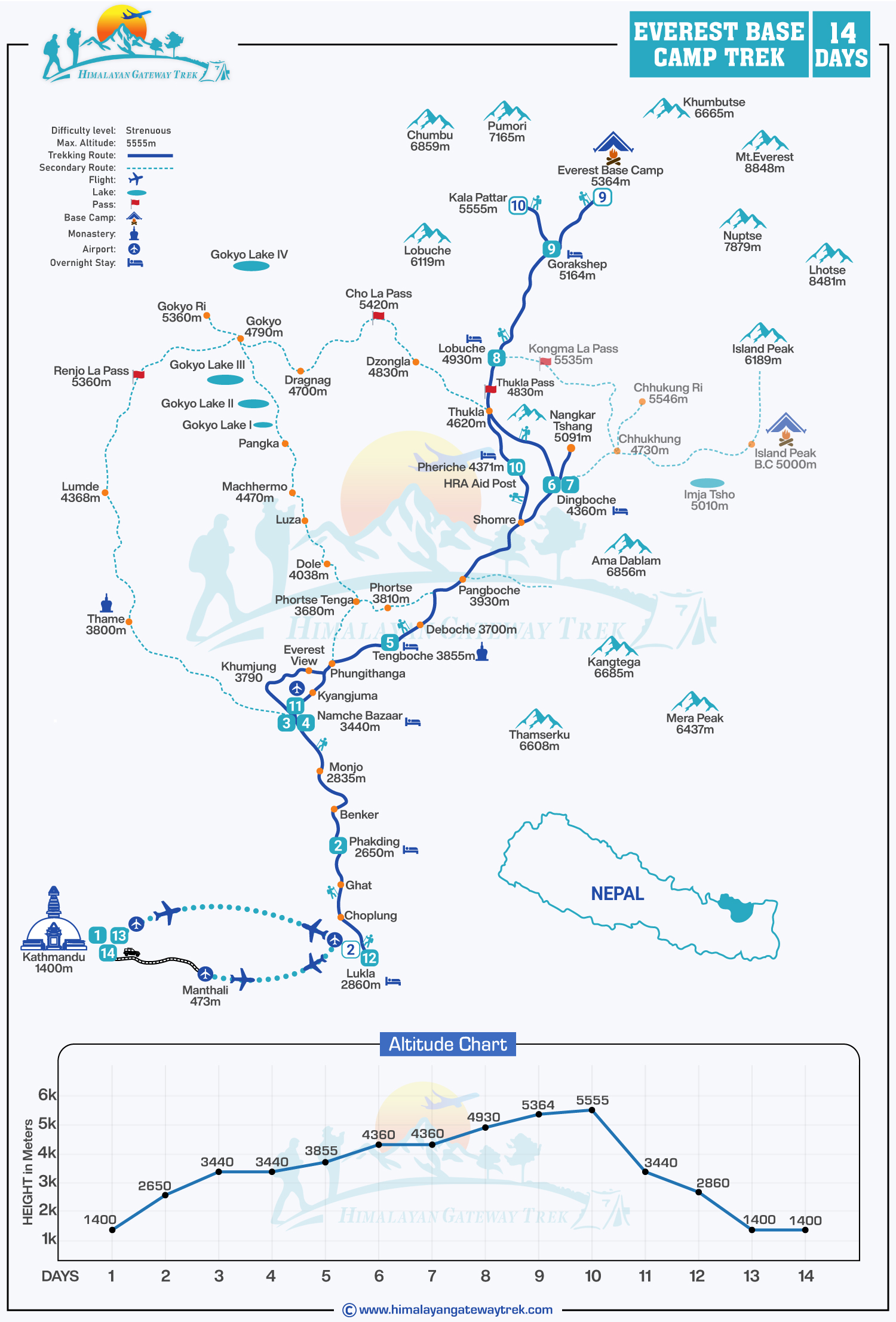
Everest Base Camp Trek Map


When preparing for the Everest Base Camp (EBC) trek, the right gear is essential to ensure both comfort and safety. Clothing is key, with moisture-wicking base layers to keep you dry and warm, and insulating layers like a fleece or down jacket to help retain body heat. A waterproof, windproof jacket and pants are crucial to protect you from the elements, and you’ll want trekking pants or shorts for comfort during the day. Don’t forget a warm hat, gloves, and a neck gaiter or buff to keep your extremities protected from the cold winds.
Footwear is another important consideration. Make sure to bring sturdy, waterproof trekking boots with good ankle support to handle the rugged terrain, as well as camp shoes like sandals to relax in during your stops. To avoid blisters, pack moisture-wicking socks, ideally with a couple of extra pairs in case they get wet.
For sleeping and safety, you’ll need a four-season sleeping bag rated for at least -10°C or 14°F to handle cold nights at higher altitudes, along with a sleeping liner for added warmth. A headlamp is essential for visibility in the dark, and trekking poles can help ease the strain on your knees and provide extra stability on uneven ground.
Finally, a daypack is needed for carrying your essentials during the trek, along with a good hydration system like a water bottle or Camelbak to stay properly hydrated at altitude. Having the right equipment will ensure you’re well-prepared for the challenges of the EBC trek, allowing you to focus on the journey ahead.
- Clothing
- Layered moisture-wicking base layers, warm fleece or down jacket, waterproof and windproof jacket and pants, trekking pants/shorts, and a warm hat, gloves, and neck gaiter.
- Footwear
- Sturdy waterproof trekking boots with good ankle support and comfortable camp shoes (sandals).
- Sleeping Gear
- A 4-season sleeping bag (rated for at least -10°C or 14°F) and a sleeping liner.
- Trekking Poles
- For added stability and reduced strain on knees.
- Headlamp
- With extra batteries for night-time visibility.
- Hydration System
- A water bottle or Camelbak to stay hydrated throughout the trek.
A guided Everest Base Camp trek provides trekkers with expert guidance, ensuring safety, efficient navigation, and a deeper understanding of the region. With an experienced guide, trekkers can navigate the challenging terrain, avoid common mistakes, and handle the high-altitude environment better. Guides are well-versed in local culture, history, and the best acclimatization techniques, making the journey both safer and more enriching.
Guided treks often include a well-planned itinerary that factors in proper acclimatization to avoid altitude sickness. Guides are skilled in managing emergency situations, providing first aid, and ensuring that trekkers stay on track. They will also arrange accommodations in teahouses and ensure comfortable, safe stays throughout the journey. A professional guide can also help with cultural interactions, giving trekkers insight into the local Sherpa communities and traditions.
A key benefit of a guided trek is having logistical support, including permits, transportation, and meals, which are all taken care of. This allows trekkers to focus entirely on the trek itself, without the stress of organizing accommodations or navigating complex routes. Most guided tours also offer a support team, including porters to carry gear, allowing trekkers to enjoy the hike with lighter packs.
Guided Everest Base Camp treks are ideal for those looking for a structured, hassle-free experience. With professional support, trekkers can tackle the challenges of the trek with confidence, knowing they are in safe hands. Whether you’re a seasoned trekker or a first-time adventurer, a guided trek ensures an unforgettable and well-supported journey to the base of the world’s highest mountain.
Free Pick and Drop from Airport
We offer a complimentary airport pick-up and drop-off service at Tribhuvan International Airport. You will then be driven to your hotel in a private vehicle.
Flight Delays
Mountain weather can affect both Lukla flights and helicopter operations. We can build extra days into the itinerary and can arrange alternative transportation if necessary.
Accomodation &Meals During the Trek
Accommodation is provided in simple, comfortable teahouses, where you’ll experience the warm hospitality of the local Sherpa people. Meals are prepared with fresh ingredients, offering a mix of traditional Nepalese dishes such as dal bhat, Tibetan bread, vegetable curries, and hot drinks to keep you energized. Vegetarian options are available, and the food is designed to replenish your energy after long trekking days.
Luggage Limit
The luggage weight limit for the Everest Base Camp Trek is 12.5kg per trekker. For every two trekkers, one porter is assigned, and the combined weight of their luggage will not exceed 25 kg.
Best Time to Trek the Everest Base Camp
The best time for the Everest Base Camp Trek is during the spring (March to May) and autumn (September to November). Spring offers mild temperatures and beautiful rhododendron blooms, while autumn provides clear skies and stable weather after the monsoon. Winter (December to February) can be extremely cold, and the monsoon season (June to August) brings rains, making the Lukla flight difficult.
Typical Day: A typical day starts with breakfast at 7:00 AM, followed by 5-7 hours of trekking with a lunch stop at a teahouse. Trekkers usually arrive at their next destination in the afternoon, with time for relaxation, acclimatization, or village exploration. Evenings are spent having dinner and preparing for the next day’s trek.
Visa: A Nepal visa can be obtained on arrival at Kathmandu Airport, with a fee of $30 for 15 days and $50 for 30 days. Be sure to bring passport-sized photos and USD cash for a smooth visa process.
Travel Insurance: It’s essential to have travel insurance that covers trekking at high altitudes, above 5,000 meters, and includes emergency evacuation. The remote nature of the trek necessitates this coverage.
Note to Travelers :
We organize private treks for groups of at least two people and do not add anyone in your group. Contact us via Call/WhatsApp/Viber at +977 - 9861197727 or email himalayangatewaytrek@gmail.com You can also use our Free Trip Planner.
Group Discount Price
FAQs
How long does the Everest Base Camp trek actually take?
The standard trek takes 12 to 14 days starting from and returning to Kathmandu. This includes two mandatory acclimatization days to ensure your body adjusts to the thinning air.
How difficult is the trek for an average person?
The trek is considered “moderately strenuous.” You do not need technical climbing skills or oxygen tanks, but you must be able to walk 5 to 7 hours per day on rocky, uphill terrain while carrying a daypack.
What is the best time of year to trek to Everest Base Camp?
There are two primary windows: Pre-monsoon (March to May) and Post-monsoon (late September to November). Spring offers blooming rhododendrons and views of climbers, while Autumn provides the clearest skies and most stable weather.
Can I do this trek solo or do I need a guide?
As of recent Nepal government regulations, it is highly recommended (and in many regions mandatory) to hire a licensed guide for safety. A guide manages logistics, communicates with locals, and monitors your health for altitude sickness.
How much training is required before I arrive?
You should begin training at least 8 to 12 weeks before your trip. Focus on cardiovascular endurance (running or swimming), leg strength (squats and lunges), and hiking on hills with a weighted pack.
Why do flights to Lukla often fly from Manthali instead of Kathmandu?
During peak seasons (Spring and Autumn), the Civil Aviation Authority often shifts Lukla flights to Manthali (Ramechhap) to reduce air traffic congestion in Kathmandu. This requires a 4 to 5 hour drive from Kathmandu starting at 2:00 AM.
What happens if my Lukla flight is delayed or cancelled?
Weather in the Himalayas is unpredictable. It is common for flights to be delayed by hours or days. We recommend building at least two “buffer days” into your international travel itinerary to account for these delays.
What is the weight limit for the flight to Lukla?
The weight limit is strictly 15kg (approximately 33 lbs) per person. This includes your main duffel bag (10kg) and your carry-on daypack (5kg).
Are there alternatives to flying into Lukla?
Yes, you can take a “Jeep Trek” from Kathmandu to Phaplu or Tham Danda and walk from there. This adds 2 to 3 days to your itinerary but avoids the flight risks and Lukla’s short runway.
What is Acute Mountain Sickness (AMS) and how do I prevent it?
AMS is caused by ascending too quickly. Symptoms include headaches, nausea, and dizziness. Prevention involves walking slowly, staying hydrated (4 liters of water daily), and following a proper acclimatization schedule.
Should I take Diamox (Acetazolamide) during the trek?
Many trekkers use Diamox as a preventative measure. You should consult your doctor before your trip. If you start taking it, it is usually recommended to begin 24 hours before you reach high altitude.
What happens in the event of a medical emergency?
If you suffer from severe altitude sickness or injury, your guide will coordinate a helicopter evacuation. This is why specialized travel insurance is mandatory for this trek.
Is the water safe to drink on the trail?
No, you should never drink tap or stream water. Use water purification tablets, a LifeStraw, or UV filters. While bottled water is available, it is expensive and creates plastic waste that is difficult to remove from the mountain.
What are the "teahouses" like?
Teahouses are simple mountain lodges. Bedrooms are usually twin-share with two wooden beds and thin mattresses. Common areas are heated by a central stove fueled by dried yak dung. Bedrooms are not heated.
What kind of food is available during the trek?
The most popular dish is Dal Bhat (lentil soup, rice, and vegetable curry), which is nutritious and offers free refills. You can also find pasta, potatoes, eggs, and even “Sherpa Stew.” We recommend avoiding meat above Namche Bazaar because it is carried up by porters and may not be fresh.
Are there hot showers available?
Most teahouses offer hot showers for an extra fee (usually 3 to 7 USD). As you get higher (above 4,000m), showers are often just a bucket of hot water. Many trekkers use wet wipes in the final days to stay clean.
Do the teahouses have electricity and Wi-Fi?
Yes, but they are not free. Charging your phone or power bank costs between 2 to 6 USD per charge. Wi-Fi is available via “Everest Link” cards, though the connection becomes less stable the higher you climb.
What are the toilet facilities like?
In lower elevations, you will find flush toilets. In higher elevations, you will likely encounter “squat” toilets. You must bring your own toilet paper, as it is rarely provided and expensive to buy on the trail.
Do I need to buy all my gear or can I rent it?
You can easily rent high-quality down jackets and sleeping bags in Kathmandu for about 1 to 2 USD per day. This saves you from buying expensive gear you might only use once.
What kind of boots do I need?
You need broken-in, waterproof hiking boots with good ankle support. Do not start the trek with brand new boots, as this will lead to blisters.
Should I use trekking poles?
Highly recommended. Trekking poles reduce the impact on your knees by up to 25 percent, which is vital during the steep descents on the return journey.
How much extra cash should I bring per day?
You should budget 25 to 40 USD per day for “extras” like hot showers, charging, Wi-Fi, snacks, and boiled water. This is in addition to your pre-paid tour price.
Are there ATMs on the Everest Base Camp trail?
There are ATMs in Lukla and Namche Bazaar, but they are frequently out of service or out of cash. It is essential to withdraw all the Nepali Rupees you need while you are in Kathmandu.
What is the standard for tipping guides and porters?
Tipping is a cultural expectation in Nepal. A general rule is to tip 10 to 15 percent of your trek cost, which is then divided among the staff.
Can you actually see the summit of Mt. Everest from Base Camp?
Surprisingly, no. From Base Camp itself, the view of the summit is blocked by the West Ridge and Lhotse. The best view of the Everest summit is from Kala Patthar (5,545m), which you will climb early in the morning.
How much weight do porters carry?
A single porter typically carries 20kg to 25kg, usually representing the bags of two trekkers. We ensure our porters are treated ethically and never overloaded.
Do I need a permit for the EBC trek?
Yes, you need two permits: the Khumbu Pasang Lhamu Rural Municipality Entrance Permit and the Sagarmatha National Park Entry Permit. If you are trekking from Jiri, you also need a Gaurishankar Conservation Area permit.
Is there cell phone reception on the trek?
Ncell and NTC have coverage in many areas, but it is spotty. In the higher villages, the signal often disappears entirely, making “Everest Link” Wi-Fi the only option for communication.
Can I do the trek if I have a gluten-free or vegan diet?
Yes. Since Dal Bhat (the local staple) is naturally vegan and gluten-free, it is very easy to find suitable meals. Just be sure to inform your guide or the teahouse owner in advance.
What is the "Khumbu Cough"?
The Khumbu Cough is a dry, persistent cough caused by the cold, dry air at high altitudes. You can prevent it by wearing a buff or mask to warm and humidify the air you breathe and by sucking on throat lozenges.
Is insurance mandatory?
Yes. Your insurance must specifically cover trekking up to 6,000 meters and include emergency helicopter evacuation. Standard travel insurance often excludes high-altitude trekking, so read the fine print carefully.