The Annapurna Circuit Trek is one of the most popular and diverse trekking routes in Nepal, offering stunning views of the Annapurna and Dhaulagiri mountain ranges. This trek takes you through a variety of landscapes, from subtropical forests to alpine meadows, as well as high deserts and rugged terrains. The highlight is crossing the Thorong La Pass (5,416 m), one of the highest trekking passes in the world. The route also provides opportunities to experience the rich culture of the region, passing through villages like Manang and Marpha, where trekkers can enjoy traditional hospitality and vibrant Tibetan Buddhist culture.
Typically taking 16-21 days, the trek provides ample time for acclimatization, allowing trekkers to gradually ascend while adjusting to the higher altitudes. The trek is renowned for its variety, with each day offering a new experience in terms of landscape, climate, and culture. With its well-maintained trails and ample teahouses along the route, the Annapurna Circuit is a favorite for both seasoned trekkers and those looking for an adventurous journey with breathtaking views and unique cultural immersion.
Highlights of Annapurna Circuit Trek
- The trek’s highest point at 5,416 meters, offering breathtaking mountain views.
- A journey through forests, meadows, deserts, and alpine terrain.
- Experience the unique cultures of Gurung, Thakali, and Tibetan villages.
- A sacred pilgrimage site revered by both Hindus and Buddhists.
- A picturesque valley with stunning views and a crucial acclimatization stop.
- Famous for its apple orchards and charming atmosphere.
- Enjoy panoramic vistas of the Annapurna and Dhaulagiri peaks.
- A popular sunrise viewpoint offering incredible views of the Annapurna massif.
Benefits of trekking with Himalayan Gateway Trek
- Friendly and knowledgeable guides for a safe and enjoyable trek.
- Flexible trekking plans based on your needs and fitness level.
- Responsible tourism that supports local people and nature.
- Organized food, lodging, and transport for a smooth trip.
- Quick help in emergencies and guidance to prevent altitude sickness.
- Personalized experience with small group sizes for better service.
- Stay in local teahouses and interact with the community.
- Fair and transparent pricing with no hidden costs.
Comprehensive Annapurna Circuit Trek Guide
Annapurna Circuit Trek Itinerary
Day 01: Day 01: Arrival at Kathmandu Airport (1,400m ) and transfer to the hotel for check-in and rest.
Upon your arrival at Tribhuvan International Airport in Kathmandu, the vibrant capital of Nepal, our friendly team from Himalayan Gateway Trek will be there to greet you with a warm welcome and take you to your hotel.
Once you arrive, you’ll receive a warm welcome, with staff presenting you with traditional flower garlands. They will assist you with the check-in process and make sure you’re comfortable. Afterward, you can relax and get ready for your adventure the next day. In the evening, walk around Thamel and have dinner whenever you like.
At Himalayan Gateway Trek, we are excited to begin this journey with you and ensure a memorable experience throughout your stay in Nepal.
Day 02: Drive from Kathmandu to Bhulbhule (845 m)
Begin your adventure with an 8-hour scenic drive from Kathmandu to Bhulbhule. The drive takes you through picturesque valleys, local villages, and along winding roads, with beautiful views of the surrounding mountains, marking the start of your trekking journey.
Day 03: Trek from Bhulbhule to Jagat (1,300 m)
Start your trek from Bhulbhule, passing through terraced fields and dense forests. The trail crosses suspension bridges and takes you along the Marsyangdi River. After about 5 hours of trekking, you’ll reach the village of Jagat, nestled in a scenic location, perfect for a rest.
Day 04: Trek from Jagat to Dharapani (1,860 m)
Continue along the river, trekking through pine forests and past several villages. You’ll begin to notice the change in landscape as you ascend toward the Tibetan-influenced village of Dharapani, which offers fantastic views of the surrounding peaks.
Day 05: Trek from Dharapani to Chame (2,610 m)
The trek today takes you through a beautiful pine forest, with glimpses of the Annapurna range. As you make your way toward Chame, you’ll cross several bridges and gain elevation, ending your day in Chame, where you can enjoy panoramic views of the surrounding mountains.
Day 06: Trek from Chame to Upper Pisang (3,300 m)
Today’s trek offers stunning views of the Annapurna massif as you make your way through alpine meadows and charming villages. The trail winds upwards to Upper Pisang, where you’ll be greeted with magnificent views of Annapurna II, Annapurna III, and the Fishtail peak.
Day 07: Trek from Pisang to Manang (3,540 m)
The trek to Manang takes you through picturesque villages and across several bridges, with views of the Annapurna and Gangapurna peaks. Manang is a vibrant Tibetan village, offering cultural immersion and a chance to rest and acclimatize before the higher altitudes.
Day 08: Rest and acclimatization day at Manang
This is an important acclimatization day. Spend the day exploring the village, visiting local monasteries, or taking short hikes around Manang to help your body adjust to the higher altitude before continuing the trek.
Day 09: Trek from Manang to Ledar (4,250 m)
Today’s trek takes you through the rugged, high-altitude terrain as you climb towards Ledar. The landscape becomes more barren, with alpine vegetation, and the air begins to thin. Ledar is a small settlement where you can rest before heading toward Thorong La Pass.
Day 10: Trek from Ledar to Thorong High Camp (4,925 m)
As you ascend towards Thorong High Camp, the altitude becomes more challenging, and the terrain becomes more exposed and barren. After reaching the camp, take the time to rest and prepare for the long day ahead at Thorong La Pass.
Day 11: Trek from Thorong High Camp to Muktinath Temple (3,760 m) via Thorong La High Pass (5,416 m)
Today is the most challenging day, as you cross Thorong La Pass, one of the highest trekking passes in the world at 5,416 meters. After reaching the summit, descend to the sacred Muktinath Temple, a significant pilgrimage site for both Hindus and Buddhists.
Day 12: Drive from Muktinath to Jomsom and Tatopani (1,200 m)
A long but scenic drive brings you from Muktinath down to Tatopani, a village famous for its natural hot springs. After the grueling trek, enjoy a well-deserved soak in the hot springs to relax your muscles.
Day 13: Trek from Tatopani to Ghorepani (2,860 m)
Today’s trek takes you uphill to the village of Ghorepani, known for its breathtaking views of the Annapurna and Dhaulagiri ranges. Ghorepani is also the base for the early morning hike to Poon Hill for a spectacular sunrise.
Day 14: Early morning hike to Poon Hill (3,210 m), then trek to Birethanti (1,039 m), drive to Nayapul and Pokhara
Wake up early to hike to Poon Hill for one of the most spectacular sunrises over the Annapurna and Dhaulagiri ranges. Afterward, trek down to Birethanti and take a drive to Nayapul. The journey concludes with a short drive to Pokhara for a relaxing evening.
Day 15: Drive from Pokhara (820 m) to Kathmandu (1,350 m)
After completing your epic trek, enjoy a scenic drive back to Kathmandu. Reflect on your incredible journey through the Annapurna Circuit and enjoy a relaxing evening in the bustling capital city.
Day 16:Departure from Kathmandu.
On the final day of your journey, you will be transferred to Kathmandu’s Tribhuvan International Airport for your departure. Depending on your flight schedule, you may have some free time to do some last-minute shopping or explore the city.
What is included in this trek package?
- Airport pickups and drops in a private vehicle
- 2 Nights hotel in Kathmandu and 1 night hotel in Pokhara with breakfast
- Teahouse accommodation during the trek
- All meals (breakfast, lunch and dinner) with tea/coffee during the trek
- Deluxe bus from Kathmandu to Bhulbhule
- Private jeep from Besisahar to Chame and Muktinath to Tatopani
- Private jeep from Birethanti to Pokhara
- An experienced, English-speaking and government-licensed trek guide and porter (1 porter:2 trekkers0
- Staff costs including their salary, insurance, equipment, food and accommodation
- Sleeping bag & Duffel bags to each trekkers (to be returned after trip completion)
- All necessary paperwork and trekking permits (ACAP, TIMS card)
- Medical kit
- Farewell dinner at typical Nepali restaurant
- Trekking certificate
- Travel & rescue arrangement (Helicopter evacuation available if required, at clients cost based on clients insurance policy).
What is excluded in this trek package?
- International flight costs
- Nepal Entry Visa Fees for multiple entries on arrival at Tribhuvan International Airport- (15 days - $30, 30 days- $50 and 90 days- $125)
- Lunch and dinner in Kathmandu and/or Pokhara
- All accommodations in Kathmandu, before and after the journey
- Extra night accommodation in Kathmandu due to early arrival or late departure, or early return from the trek.
- Personal expenses (phone calls, laundry, bar bills, battery recharge, extra porters, bottle or boiled water, shower, etc.)
- Tips for guide(s), porter(s) and driver(s)
Annapurna Circuit Trek Route Map
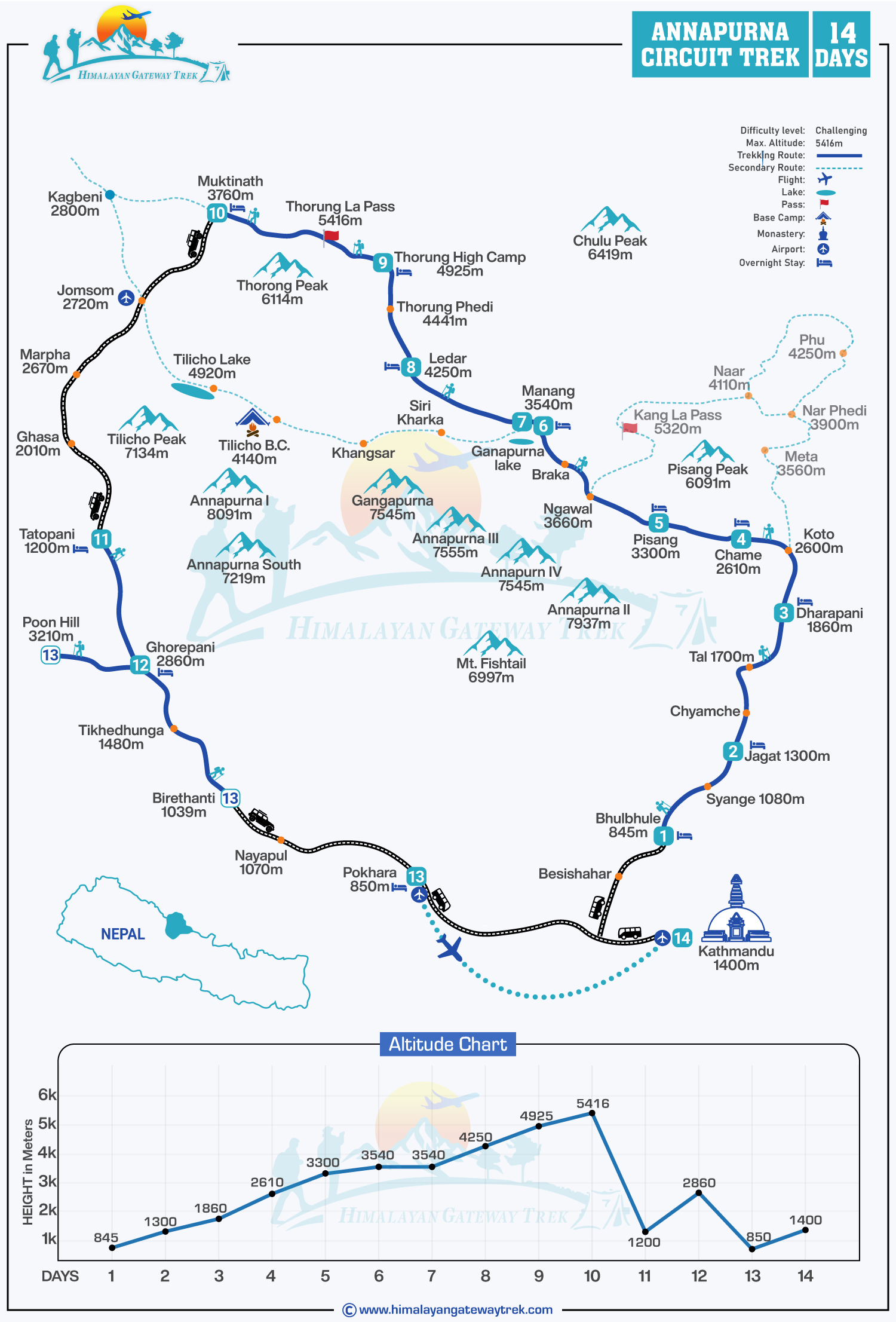


For the Annapurna Circuit Trek, packing smart is crucial as you’ll be traversing diverse terrains, from lush valleys to high-altitude passes with changing weather conditions. Layering your clothing is key to staying comfortable. Begin with moisture-wicking base layers to keep sweat away from your skin, followed by an insulating fleece or down jacket for warmth. Top off with a waterproof and windproof shell to protect against rain, snow, and cold winds. Make sure to bring trekking pants, quick-dry shirts, and warm accessories like gloves, a beanie, and a neck gaiter to adapt to the varying temperatures.
Your trekking footwear should include sturdy boots with good ankle support to handle the rugged and rocky trails. Pair them with thermal socks to keep your feet warm, and pack gaiters to protect your legs from snow or mud. A lightweight pair of camp shoes or sandals will offer your feet relief at the end of the day. For sleeping, bring a sleeping bag rated for temperatures as low as -10°C to -15°C, and consider a sleeping bag liner for added insulation. A 50-65L backpack will fit your essentials, while a smaller 20-30L daypack is handy for carrying water, snacks, and extra layers on daily hikes.
Hydration is essential during the trek, so carry a refillable water bottle or hydration bladder. A water purification system, such as purification tablets, a filter, or a SteriPEN, ensures safe drinking water. Energy-dense snacks like nuts, protein bars, and dried fruits will keep your energy levels up between meals. A basic first-aid kit should include medication for altitude sickness, pain relievers, blister treatment, and any personal prescriptions. Don’t forget sunscreen (SPF 50+), lip balm with SPF, and UV-protection sunglasses to shield yourself from the intense mountain sun.
To make your trek more manageable, consider bringing adjustable trekking poles to ease the strain on your knees and improve balance on steep or uneven terrain. A headlamp with extra batteries will be useful for early starts or evening walks, and a power bank or solar charger ensures you can keep your devices charged in remote areas without electricity. Lastly, bring wet wipes, biodegradable soap, and a quick-dry towel for hygiene, especially on the days when shower facilities are unavailable.
- Moisture-wicking thermal tops & bottoms.
- Fleece or down jacket for warmth.
- Waterproof & windproof jacket and pants.
- Woolen or fleece hat, waterproof gloves.
- Neck Gaiter/Buff for warmth and dust protection.
- Trekking Boots .
- Trekking Backpack (30-40L).
- Duffel Bag/Rucksack (provided by trekking agency if applicable).
- Sunglasses: UV protection for high-altitude sun exposure.
- Water Bottles & Hydration Bladder (2L capacity).
- Toothbrush, Toothpaste, & Biodegradable Soap.
- Lip Balm & Sunscreen (SPF 50+).
- Basic First Aid Kit (bandages, antiseptic, pain relievers, etc.).
- Energy Bars, Chocolates, Dried Fruits, or Nuts.
- Altitude Sickness Medicine .
- Layered Clothing
- Moisture-wicking base layers, insulating fleece or down jacket, and a waterproof/windproof shell for varying weather conditions.
- Footwear
- Sturdy trekking boots with good ankle support, thermal socks, gaiters for snow/mud, and camp shoes for relaxation.
- Sleeping Gear
- A sleeping bag rated for -10°C to -15°C and a sleeping bag liner for extra warmth.
- Hydration & Snacks
- Refillable water bottle, water purification system (tablets/filters), and high-energy snacks like nuts, bars, and dried fruits.
- Essential gear
- Trekking poles, headlamp with extra batteries, sunscreen (SPF 50+), lip balm, UV-protection sunglasses, and a first-aid kit.
Best Seasons
The best time for the Annapurna Circuit Trek is during the spring (March to May) and autumn (September to November). Spring offers mild temperatures and beautiful rhododendron blooms, while autumn provides clear skies and stable weather after the monsoon. Winter (December to February) can be extremely cold, and the monsoon season (June to August) brings heavy rains, making the trails challenging.
Typical Day
A typical day begins early, with breakfast around 6:30 to 7:00 AM, followed by 5-7 hours of hiking, including a lunch break at a teahouse. The trail takes you through remote villages, lush forests, and alpine meadows. By afternoon, you’ll arrive at your next teahouse or campsite. Evenings are spent enjoying a warm meal, relaxing, and preparing for the next day’s trek. Accommodations are basic, with limited facilities.
Transportation & Flight Delays
Unlike some other treks, the Annapurna Circuit does not involve flights. The journey starts with a drive from Pokhara to Besisahar, and from there, you begin the trek. The road conditions can be unpredictable, so it’s a good idea to allow for extra time in case of delays, particularly during the monsoon season when landslides can affect travel.
Visa & Permits
You can obtain a Nepal visa upon arrival at Kathmandu Airport, with a fee of $30 for 15 days and $50 for 30 days. For the Annapurna region, you’ll need two permits: the Annapurna Conservation Area Permit (ACAP) and the TIMS card. These can be obtained in Kathmandu or Pokhara before starting your trek.
Travel Insurance
Travel insurance is essential for the Annapurna Circuit Trek. Your insurance should cover trekking above 4,000 meters and include emergency evacuation via helicopter for any medical issues or altitude sickness.
Note to Travelers :
We organize private treks for groups of at least two people and do not add anyone in your group. Contact us via Call/WhatsApp/Viber at +977 - 9861197727 or email himalayangatewaytrek@gmail.com You can also use our Free Trip Planner.
Group Discount Price
FAQs
How difficult is the Annapurna Circuit trek?
It is a test of endurance rather than technical skill. You will be trekking 5–7 hours daily for nearly two weeks. The “crux” is Thorong La Pass (5,416m), where oxygen levels are 50% lower than at sea level. If you can hike 15km with a light pack back-to-back for three days, you have the baseline fitness. We recommend focused cardio and stair-climbing training 3 months prior.
When is the absolute best time to go?
Best time to go for Annapurna Circuit Trek is:
- Autumn (Post-Monsoon): Offers the crispest, “high-definition” mountain views and stable weather, though trails are social and busy.
-
Spring (Pre-Monsoon): Best for nature lovers; the rhododendrons are in bloom, and the temperatures at high altitudes are slightly warmer, though haze can build in the afternoons.
Pro Tip: Early December is a “hidden gem” window—bone-dry, clear skies, and empty trails, provided you can handle the colder nights.
Has the new road ruined the Annapurna Circuit?
This is a common myth. While roads have reached Manang and Muktinath, we use NATT (Natural Annapurna Trekking Trails). These are specifically mapped trails that bypass the road entirely, keeping you in the forest and on ancient stone paths. The road actually provides a safety net for emergency evacuations and allows for a more flexible itinerary if you get tired.
Do I need a guide, or can I trek solo?
As of 2023, the Nepal Tourism Board has mandated that all trekkers in national parks must be accompanied by a licensed guide. Beyond legalities, a guide is your cultural translator and safety officer. They spot early signs of Altitude Sickness (AMS) that you might ignore and secure the best rooms in teahouses during peak season.
What is the accommodation like?
You will stay in “Teahouses” family-run mountain lodges. Expect twin-sharing rooms with wooden beds and foam mattresses. Lower elevations often have attached bathrooms and hot showers. Above Manang, facilities become “alpine-basic” (common toilets, bucket showers). Most common areas are heated by a central wood/yak-dung stove in the evenings.
Can I get a hot shower every day?
Down low, yes (gas or solar). As you go higher (above 3,500m), showers become expensive ($3-$5) and risky, as stripping down in freezing air can lead to “Khumbu Cough” or chills. Most experienced trekkers use “wet wipe marathons” for the 3-4 days around the Pass.
Is there Wi-Fi and cell service on the trail?
Yes, Ncell and Nepal Telecom (NTC) work in many villages. Teahouses offer Wi-Fi for a small fee, but it is notoriously “mountain-speed” fine for WhatsApp, bad for Netflix. We recommend buying a local SIM card in Kathmandu for the most reliable data.
How do I manage drinking water without buying plastic bottles?
Sustainability is key. We discourage buying plastic bottles. Use a reusable bottle (like Nalgene) or a bladder. You can treat tap water using purification tablets (Aquatabs) or a UV Steripen. Safe drinking water stations also exist in many villages for a small fee.
What happens if I get Altitude Sickness?
Safety is our priority. If you show symptoms of AMS, our “Safety First” protocol kicks in:
1. Immediate descent to a lower elevation.
2. Administration of Diamox or oxygen if necessary.
3. If symptoms persist, we coordinate a helicopter evacuation via your insurance.
Can I charge my phone and camera?
Yes, but it’s rarely free. Teahouses charge $2–$5 per device to charge in the common room. A high-capacity power bank (20,000mAh) is a must-have to save money and stay powered during the colder nights when batteries drain faster.
What is the "Weight Limit" for my trekking bag?
If you are taking the internal flight from Jomsom to Pokhara, the strict limit is 15kg (including your carry-on). For the trek itself, our porters carry up to 10kg-12kg per person (usually one porter for two trekkers). We provide a detailed packing list to help you stay under this limit while ensuring you have every essential for the 5,416m pass.
Is the Annapurna Circuit safe for solo female travelers?
Yes, and it is one of the most popular trails for women. However, per the 2023 mandate, you must have a guide. We can pair you with a female guide (upon request/availability) or place you in a group of like-minded international travelers. Our guides are trained in safety protocols specifically for solo travelers to ensure you feel secure from the trail to the teahouse.
What happens if Thorong La Pass is closed due to snow?
Safety is non-negotiable. If the pass is blocked by heavy snow, our guides have the authority to pivot the itinerary. We usually wait 24 hours for a window, but if it’s unsafe, we backtrack to a lower elevation and explore the stunning Tilicho Lake or the hidden valleys of Upper Manang. You will still have a world-class experience; we just change the “peak.”
Do I need "Rescue Insurance" specifically?
Standard travel insurance is not enough. You need a policy that covers “Emergency Helicopter Evacuation” up to 6,000 meters. Check the fine print! If your policy doesn’t cover this, we can recommend specialized providers like World Nomads or Global Rescue that we have worked with successfully for years.